Welcome to Friday Vision where we expose the depth of our institutional decay and present the blueprints required for long-term solutions.
Almost everyone agrees that America’s immigration system is broken. That may be the only thing almost everyone agrees on. Past that point, the conversation falls apart into slogans. Build the wall. Abolish ICE. Mass deportation. Open borders. Each side treats the other as the problem, and every couple of years we get a fresh round of promises that go nowhere.
The story underneath all of that noise is this. The system has been broken in much the same ways for about forty years, and it keeps getting worse. Not because the problem cannot be solved, but because hardly anyone in Washington has been willing to define it clearly before reaching for a microphone. Solutions get announced before the problem is understood. Enforcement gets ramped up before the courts are funded. Legal doors get shut before anyone builds new ones.
The result is a system that serves no one. It does not serve American workers, or American employers, or the millions of people living in legal limbo, or the taxpayers who pay for all of it. It does not even serve the politicians, who keep promising to fix it and failing.
This article walks through the whole story in no more than a 5–10 minute read. How immigration used to work. The moments when it broke. What the system looks like today. And how we can realistically get it back on track. It is a short version of two longer research reports we have published, which are there for you whenever you have the time.
How Immigration Used to Work
For most of American history, immigration simply worked. It did not work because someone designed it cleverly. It worked because it matched a basic reality. A young country with enormous land and a constant shortage of labor needed people, and people came.
The founders understood this. One of the grievances in the Declaration of Independence was that King George had been “obstructing the Laws for Naturalization of Foreigners.” Immigration was treated as a national strength, not a threat. For most of the nineteenth century there were no visa systems, no numerical limits, and no quotas. Between 1815 and 1930, the country took in more than thirty million immigrants from Europe alone.
That open era did not last. Beginning with the Chinese Exclusion Act of 1882, Congress started closing the doors, often along plainly racial lines. The major turning point came in 1921 and 1924, when Congress set the first comprehensive numerical quotas in the nation’s history. They were written to favor Northern and Western Europeans and to shut out arrivals from Southern and Eastern Europe, Asia, and Africa. Total immigration fell from more than 800,000 a year to around 150,000.
Then came two laws that still shape everything today.
The Immigration and Nationality Act of 1952 gathered the scattered rules into one master statute. It finally removed race as an outright bar to citizenship, but it kept the national-origin quotas in place. That 1952 law is still the foundation of American immigration law today. It has been amended many times, but never replaced.
The larger change came in 1965, when President Lyndon Johnson signed the Hart-Celler Act at the foot of the Statue of Liberty. It abolished the national-origin quotas and built a new system around family reunification. Its sponsors promised it would barely change the makeup of the country. Senator Ted Kennedy assured the nation that “the ethnic mix of this country will not be upset.” They were wrong, and the reason still matters.
The family reunification system let immigrants sponsor relatives, and those relatives could sponsor relatives of their own. Over the decades, that chain shifted American immigration away from Europe and toward Asia and Latin America. But the 1965 law did something else that almost no one noticed at the time. For the first time, it placed a cap on immigration from the Western Hemisphere, which included Mexico.
For generations, people had moved back and forth across the southern border freely, following the work. Now there were limits that had nothing to do with the deep economic ties between the two countries. When the legal door closes but the work on the other side does not go away, people do not stop coming. They come another way. Unauthorized immigration from Mexico and Central America became all but inevitable the moment that cap was set, and that dynamic has never been fixed.
The Four Moments That Broke the System
If 1965 set the trap, four later decisions sprang it. Each made the same basic mistake. Each pushed hard on one side of the system while leaving the other side alone.
1986: A Grand Bargain That Backfired
By the 1980s the unauthorized population had grown large. Congress responded with the Immigration Reform and Control Act of 1986, which President Reagan signed in a rare bipartisan moment. It was meant to be a grand bargain. Legalize the people already here, and crack down on the illegal hiring that drew the next wave.
The first half worked. About four million people, including roughly 1.3 million farmworkers, received legal status.
The second half did not work at all. Employers were now required to check their workers’ documents, but they only had to confirm that the papers “reasonably appeared” genuine. They did not have to verify that the documents were real. Within four years, the government’s own auditors reported that this loophole had made employer enforcement close to meaningless. An employer could knowingly accept fake papers and still comply with the law.
So the country legalized millions of people while leaving in place a reliable way to hire the next several million. Between 1986 and 2000, the unauthorized population grew from about three million to about eight million. The grand bargain delivered neither order nor enforcement.
1990: The Caps That Were Frozen in Place
The Immigration Act of 1990 was the last time Congress meaningfully set the levels for legal immigration. It created the H-1B visa for skilled workers, and it set the numerical caps that we still use, in essence, today.
Those caps were built for the economy of 1990, the year before the World Wide Web came online. The workforce has changed since then. The economy has changed. The country has changed. The caps have not.
The results are hard to believe. Employment-based green cards are capped at roughly 140,000 a year, and no single country is allowed more than seven percent of the total. India, with 1.4 billion people and an enormous professional class, gets the same allocation as Iceland. So a skilled worker from India in certain categories now faces a wait measured not in years but in lifetimes. The Migration Policy Institute has noted that some applicants are effectively scheduled to wait 223 years, an impossibility written into law and left untouched since the first President Bush. We bring talented students into our universities, train them in our graduate programs, and then push many of them out. Canada, Australia, and Germany are glad to take them, because they built systems that respond to real demand. We did not.
1996: More Enforcement, No New Doors
In 1996, President Clinton signed a law that sharply expanded enforcement. More detention. More grounds for deportation. Faster removals. What it did not do was open a single new legal pathway. This is the central imbalance of the last thirty years. Enforcement keeps expanding, while legal immigration stays frozen at the levels set in 1990.
The 1996 law also backfired badly. It created three-year and ten-year bans on re-entry for anyone who had been in the country illegally and then left. Before this, a great many Mexican workers came for the season and then went home to their families. The new bans made leaving dangerous. Step out of the country, and you might be locked out for a decade. So people stopped leaving. A law meant to push unauthorized immigrants out instead trapped them inside, turning a seasonal, back-and-forth pattern into permanent settlement.
After 9/11: A System Divided Against Itself
The attacks of 2001 set off the largest reorganization of the immigration agencies in the nation’s history. The old Immigration and Naturalization Service was broken into three pieces inside the new Department of Homeland Security: USCIS for applications and benefits, Customs and Border Protection for the border, and ICE for enforcement inside the country. Meanwhile, the immigration courts were left in an entirely different department, the Department of Justice. So a single system is now run by four agencies across two cabinet departments, each with its own budget, leadership, and culture. When these pieces fail to coordinate, it is not an accident. It is built into the design.
There is one more piece to this, and it did the most damage. After 9/11, enforcement funding grew enormously. Border Patrol staffing doubled. ICE detention budgets swelled. But the courts that were supposed to decide the cases that enforcement produced barely grew at all. We built a powerful machine for catching people and a small, starved one for judging them. The backlog that followed was entirely predictable.
What the System Actually Looks Like Today
Set the politics aside and look at the machinery itself. It is in worse shape than most people realize.
Only three narrow doors
There are exactly three legal ways to immigrate permanently. Through family. Through an employer. Or through humanitarian protection, such as asylum. For most of the world, all three are closed.
Family-based immigration is the largest category, but outside of the immediate relatives of citizens, the waits are staggering. Filipino brothers and sisters of U.S. citizens who applied in 1998 are only now becoming eligible. Employment-based immigration, as we have seen, is capped and limited by country to the point where it no longer makes sense. And there is no general skilled-worker visa, no points system, for a person who has valuable skills but no employer to sponsor them and no family already here. If you do not fit through one of the three narrow doors, there is no legal way in.
A court system that has collapsed
The clearest measure of failure is the immigration court backlog. As of April 2026, it stands at more than 3.2 million active cases. In 2015 it was about 475,000. It has grown roughly eightfold in a single decade.
The average case now waits more than four years. During that time, people cannot get any certainty about their future. They often cannot work legally, and they cannot reunite with family. And they frequently face all of this alone, because only about thirty percent of people in deportation proceedings have a lawyer.
One number settles the argument. Fewer than two percent of new immigration court cases involve any allegation of criminal activity beyond the crossing itself. The courts are not clogged with dangerous criminals. They are clogged with people who overstayed a visa, or crossed without papers, or are seeking asylum, all moving through a court system that was never designed to carry this kind of weight.
People who followed the rules are stuck too
Separate from the courts is the backlog at USCIS, the agency that processes legal applications. It has more than tripled in a decade, to more than ten million pending cases. These are not people who crossed the border. These are people who did everything the right way, who filed the forms, paid the fees, and submitted the paperwork, and now wait years for an answer. When the legal system punishes the people who follow the rules, it has stopped working.
An asylum system built for another world
The asylum system was created in 1980, for the world of the Cold War. It was designed to handle a small number of individuals fleeing political persecution, one case at a time. That world is gone. Worldwide, the number of displaced people now exceeds 120 million. And the forces driving people out of Central America today, gang violence, the failure of crops in a changing climate, economic collapse, and governments too corrupt to protect their own citizens, do not fit neatly inside the narrow 1980 definition of a refugee. The result is that more than half of asylum claims are eventually denied on the merits, but only after the applicants have waited years for a decision. That does not mean the claims are frauds. It means the legal standard no longer matches the real reasons people are fleeing.
The border numbers swing, but the pressure stays
The number of people arriving at the border is highly volatile. It peaked at nearly 250,000 in a single month in late 2023, then fell below 10,000 a month by early 2025. That swing tells us enforcement and policy do affect migration, and the border can be managed when there is political will to manage it. But it does not touch the deeper problem. As long as the legal pathways stay broken and the work on the other side keeps drawing people north, the pressure toward unauthorized migration never goes away. It only waits.
The Part Neither Party Likes to Say Out Loud
Any serious look at immigration has to deal with two facts neither party is comfortable saying in public.
The first is that immigrants, including those here without authorization, are central to the American economy. Foreign-born workers make up about 18.6 percent of the labor force, roughly twenty-nine million people. They are about seventy-three percent of farmworkers and about a quarter of construction workers. Unauthorized workers in particular paid an estimated 11.7 billion dollars in Social Security taxes and three billion dollars in Medicare taxes in a single year, paying into programs they are not even allowed to draw from. The Congressional Budget Office estimated that the recent surge in immigration would add roughly 8.9 trillion dollars to the economy over a decade. These are not talking points. They are measured facts.
This is why enforcement-only approaches keep failing. When an industry has a real, structural need for workers that the legal system refuses to supply, unauthorized employment continues no matter how tough the border becomes. We can deport people, but we cannot deport the economic demand that draws them here.
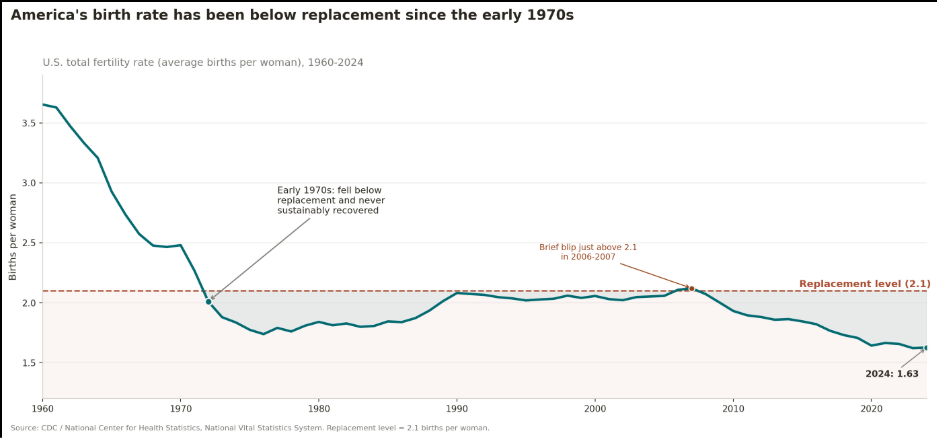
The second fact is that America is growing older. Our birth rate has been below the replacement level since the early 1970s. The baby boomers are retiring, and the number of workers supporting each Social Security and Medicare beneficiary keeps shrinking. For most of our history, immigration is the main thing that has kept the working-age population growing. This is not a matter of opinion. It is arithmetic. Without immigration, the funding problems facing Social Security and Medicare get structurally worse, and neither party has been willing to say so plainly.
The U.S. total fertility rate, or average births per woman, from 1960 to 2024. The rate crossed below the 2.1 replacement level in the early 1970s and has remained below it ever since, apart from a brief rise just above the line in 2006 and 2007. Source: CDC, National Center for Health Statistics, National Vital Statistics System.
There is a deeper cause that sits entirely outside our borders. People leave Mexico and Central America mainly because of poverty, violence, corruption, and, more and more, the failure of crops in a changing climate. A farmer in Guatemala whose harvest has failed three years running, who faces extortion from a gang the government cannot stop, is not studying American visa law before he decides to leave. He is trying to survive. A policy that deals only with what happens at our border, while ignoring why people leave home, treats the symptom and calls it a cure.
How We Get Back on Track
There is good news buried under all of this. The problem can be solved. Not easily, and not without cost, but it can be solved. The failures of the last forty years were not random. They share a single root mistake, and once that mistake is clear, the path forward becomes clear with it.
The one principle that changes everything
Every major reform since 1986 expanded enforcement without expanding either the legal pathways or the capacity of the courts. The lesson of that history is plain. Enforcement and legal pathways have to grow together. Push hard on enforcement while keeping the legal doors shut, and the unauthorized population does not shrink. It grows. That is exactly what happened in 1986, and again after 1996.
So the answer is not enforcement first, and it is not pathways first. It is both, designed and built as one connected system. The full reform plan organizes the work into six tracks.
1. Modernize legal immigration
Replace the frozen 1990 caps with a system that responds to real demand. Canada’s Express Entry system processes skilled-worker applications in about six months, using a points-based ranking, and Australia runs something similar. America can do the same. Set employment-based visas at a sensible floor, at least 200,000 a year, and adjust the numbers regularly based on real labor-market data. Scrap the per-country caps that produce century-long waits, and rank applicants on skills and experience. Speed up the family categories for spouses and young children. And clear the ten-million-case USCIS backlog on a defined ten-year schedule, so that following the rules actually works again.
2. Make employer verification real
The loophole from 1986 is still open. The fix is mandatory, nationwide E-Verify, the electronic system that checks work authorization in real time, phased in over five years and beginning with large employers and federal contractors. States that adopted it saw unauthorized employment fall significantly. But there is a condition that cannot be skipped. Mandatory verification only works if the legal pathways expand at the same time. If they do not, the work simply moves further underground. So the plan pairs E-Verify with strong protections for legal workers who get wrongly flagged.
3. Rebuild the courts
Take the immigration courts out of the Department of Justice and make them genuinely independent, as an Article I court system with judges who serve fixed terms and are free from political pressure. A bill to do exactly that, the Real Courts, Rule of Law Act, was introduced in 2026. Then fund the courts to clear the backlog, with roughly 1,500 judges added over five years, along with the support staff and legal representation the work requires. The financial case is simple. Holding a person in detention costs about 150 dollars a day, and resolving cases in months instead of years saves far more than the judges cost.
4. Modernize asylum
Update the 1980 definition of a refugee so that it reflects the forces actually driving migration today, such as the collapse of a government’s ability to protect its people from widespread violence, or a genuine environmental catastrophe. Add fast, professional screening at the ports of entry, handled by trained asylum officers rather than Border Patrol, that can sort credible claims from weak ones within thirty days. And create a temporary protected category for people fleeing real danger who do not quite meet the asylum standard, rather than leaving them in a permanent shadow.
5. Resolve the long-term unauthorized population
About ten to fourteen million people live here without authorization, and roughly sixty percent of them have been here for a decade or more. They have homes, businesses, and American-born children. No serious plan exists to deport all of them, and every economic study says that trying would be devastating. The plan, modeled on the bipartisan Dignity Act of 2025, offers a structured status it calls Earned Presence. It is a ten-year legal status for people who have been here since before 2021, who pass a background check, who have no serious criminal record, and who pay fees and restitution. It is not amnesty, and it is not an automatic path to citizenship. After ten years, a person can apply through the normal channels, the same as anyone else. And all of it is tied directly to the verification and court reforms happening at the same time. The mistake of 1986, legalizing people without fixing the system around them, must not be repeated.
6. Address the root causes
Finally, invest in the countries people are leaving, through a long-term Regional Development Compact with Mexico, Guatemala, Honduras, and El Salvador, built on the logic of the Marshall Plan rather than on short-term aid. The arrangement is straightforward. Sustained investment over fifteen years, in exchange for verifiable reforms in governance, the rule of law, the fight against corruption, and agriculture. Most of the money flows through private-sector projects under independent oversight, not blank checks to governments. This is not charity. It is a calculation about our own national security. The cost of endless enforcement at the border is far greater than the cost of reducing the pressure at its source. But the plan is honest about the timeline. This kind of development pays off over a generation, not over a news cycle.
Building a system that lasts
There is a reason past reforms keep failing, and it is not only that the policies were flawed. It is that the system has no way to keep itself up to date. The 1990 caps stayed frozen for thirty-five years because nothing ever forced anyone to revisit them.
So the plan adds two safeguards. The first is an independent Immigration Policy Commission, modeled on the Federal Reserve, which would monitor the system, set demand-based visa levels using real data, and report to the public on whether the reforms are working. The second is a required review of immigration law every ten years, with binding recommendations that Congress must vote on. It cannot force Congress to agree, but it can force it to act, so that the system never again drifts for decades while everyone looks the other way.
Why It Has Not Happened, and Why It Still Can
If the path is this clear, the obvious question is why no one has walked it. The honest answer is uncomfortable. A broken immigration system is useful to the people who are supposed to fix it. As we have written before, an unsolved problem raises money, turns out the base, and gives each side someone to blame. A solved problem is yesterday’s news. For forty years, the incentives have quietly favored leaving it broken.
But that is a choice, not a law of nature. The system cannot be fixed by enforcement alone, or by legalization alone, or by any single slogan. It can be fixed by a clear-eyed, evidence-based plan that repairs all of the broken pieces at the same time. A legal system that matches reality. Courts funded as seriously as enforcement. An asylum framework built for this century. An honest resolution for the people already here. And real investment in the reasons people leave home.
None of this is painless, and none of it is free. But the alternative is the path we are already on, a system that keeps deteriorating, a backlog that keeps growing, millions of people in limbo, and an economy that quietly depends on a workforce we refuse to acknowledge. That is not a stable arrangement. It is a slow failure we have gotten used to. We do not have to keep doing this. We only have to define the problem plainly and then fix it on purpose. That is what serious governing has always looked like.
Want the Full Story?
This article is the short version. If you want the complete history, the underlying data, and the detailed plan, the Centercratic Party has published two in-depth research reports.