


Last week, the New York Times published a sobering analysis of the 2025 congressional session: “How the House Slumped to Historic Lows of Productivity in 2025.”[1]
The data they presented is damning: 362 roll call votes, only 64 bills enacted into law, a chamber paralyzed by gridlock even while Republicans controlled the House, Senate, and presidency.
They told an important part of the story. But it’s only the tip of a much larger crisis: the systematic decline of American legislative power over seventy years.
This isn’t a story about 2025. This is a story about what happens when an institution loses its purpose, one year at a time, over decades.
The Seven-Decade Collapse: A Historical Reckoning
Let’s start with what the data actually shows.
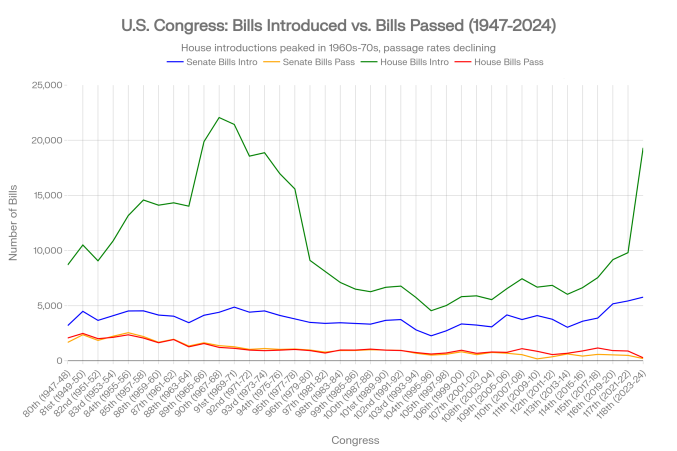
In 1965, during Lyndon Johnson’s Great Society Congress, the House introduced nearly 20,000 bills.[2] The Senate operated at full capacity, passing thousands of bills into law. Legislators were busy, often arguing fiercely about the direction of the country, but they were legislating. They were solving problems. They were passing laws.
By 2025, the House introduced fewer than 10,000 bills, half the volume of a half-century ago. The Senate, despite introducing a record number of bills (5,428), passed only 490.[1] Sixty-four bills became law. That’s it. In a year when one party controlled everything.
Let that sink in.
In the early 1950s, Congress passed roughly 900 bills into law per Congress. By 2025, that number had collapsed to 64. That represents a 93 percent decline in legislative capacity over seventy years.
This isn’t cyclical. This isn’t an anomaly. This is a pattern that has been unfolding since the 1970s, accelerating through the 1980s and 1990s, and now approaching complete institutional failure. Congress went from enacting 900+ laws per Congress in the 1950s to just 64 in 2025, a relentless downward slope for 75 years. Don’t believe me? After reading this article, please examine the chart in Appendix A titled, “U.S. Congress: Bills Introduced vs. Bills Passed (1947–2024)”. I think you will be alarmed.
The facts tell the story:
Bills Enacted (laws passed): From an average of 920 per Congress in 1950 to 362 in 2022, with 2025 plummeting to 64[1]
Passage Rates: From 54 percent of bills passing the Senate in 1956 to 1.2 percent in 2025[3]
Legislative Complexity: Bills have expanded from an average of 2.5 pages to 24.5 pages, or roughly 625 words to 6,000+ words per bill, a tenfold increase[2]
Sitting in Session: The House spent nearly eight weeks out of session in 2025, coinciding with the longest government shutdown in American history[1]
Congress isn’t just less productive. Congress is now irrelevant.
The Gridlock Paradox: Fewer Bills, But Each a Monster
Here’s something remarkable that nobody talks about: As Congress passes fewer bills, each bill becomes dramatically longer and more complex.
This is backwards. You’d expect streamlined, focused legislation. Instead, you get comprehensive omnibus bills that try to cram multiple policy objectives into a single bloated package and then get stuck in gridlock anyway. Congress is caught in a trap:
Individual bills can’t pass because they’re too controversial
So members try to bundle them together to find compromise
But that makes them even more complex and controversial
So fewer pass anyway
In 1950, Congress passed 921 bills averaging 2.5 pages each. In 2025, Congress passed 64 bills averaging 24.5 pages each.
The math is devastating: 921 bills × 2.5 pages = 2,303 pages of legislation enacted in 1950. 64 bills × 24.5 pages = 1,568 pages of legislation enacted in 2025. Congress is enacting less policy while spending more time on each bill.
What Broken Looks Like
The New York Times captured the immediate cause: Speaker Mike Johnson, terrified of drawing President Trump’s ire, spent more time avoiding votes than calling them. He maneuvered to prevent the House from voting on canceling Trump’s tariffs. He blocked a bipartisan bill to extend healthcare subsidies. He evaded votes on releasing the Epstein files.[1]
His own party members, including die-hard Trump allies like Marjorie Taylor Greene, were so fed up with the dysfunction that they started heading for the exits, deliberately shrinking their own majority.
Members had to use what’s known as a discharge petition (an arcane maneuver that effectively goes around the speaker) four times in 2025 to force votes on anything the leadership didn’t want to address. Before 2025, this had rarely succeeded.[1]
And while Congress spun its wheels on actual legislation, it erupted in partisan warfare, censuring and reprimanding members on the House floor at a pace not seen since 2023, when the body was so dysfunctional it expelled one of its own members.
Here are four metrics that showcase 2025’s unprecedented breakdown:
362 roll call votes (second lowest in 25 years)[1]
64 bills enacted (tied for worst since 2001)[1]
8 weeks out of session (longest govt. shutdown ever)[1]
4 successful discharge petitions (rare maneuver to override Speaker)[1]
This is what institutional collapse looks like: not with a bang, but with members of the same party working against each other, using arcane parliamentary procedures to override their own leadership, while the body loses the capacity to do anything meaningful.
But here’s the critical insight the New York Times missed:
This is not unique to 2025. This is not unique to Republican control. This is the predictable endpoint of a seventy-year decline.
Both Parties Built This Collapse
Let’s be direct about something uncomfortable: Both parties contributed to this catastrophe.
The decline began in the late 1970s, accelerated through the Reagan and Bush years, continued through Clinton, sped up under George W. Bush, and achieved new lows under Obama, Trump, and Biden. This is not a partisan failure. This is an institutional failure that both parties have participated in creating.[4]
In 1956, 56 percent of introduced bills became law.[2] In 2025, it’s 1.2 percent. House passage rates have similarly collapsed. This happened across Democratic administrations, Republican administrations, and divided governments.
The decline is constant. Relentless. It doesn’t matter which party is in power. Why? Because the ROOT CAUSE isn’t which party controls Congress. The root cause is something far deeper that both parties have been complicit in allowing.
How Money Pushed the Parties to the Extremes
Here’s what the data reveals when you trace it carefully:
The Root Cause: Beginning in the 1970s and accelerating dramatically after Citizens United in 2010,[5] special interest money fundamentally transformed both political parties. Money flowed not to moderate, consensus-building candidates, but to ideological purists at the party extremes. This created a perverse incentive structure where politicians survive not by appealing to the broad center, but by appealing to donors and activists at the ideological fringes.
Up until the late 1960s, American political parties were genuine organizations. Local Democratic and Republican clubs met year-round. They recruited candidates from their neighborhoods. Party bosses controlled nominations. The actual power and decision making happened in the political middle, among moderates of both parties, where consensus could be built.
Then special interest money changed everything. As wealthy donors and ideological foundations began pouring unlimited resources into politics (especially post-Citizens United), they didn’t fund centrist candidates.5 They funded their ideological allies: immigration hardliners on the right, climate absolutists on the left, anti-tax billionaires funding Republicans, maximum-government advocates funding Democrats. These donors didn’t want compromise. They wanted total victory on their single issue. They demanded ideological purity, not bipartisan pragmatism.
The result: Both parties migrated toward their extremes simultaneously, abandoning the center where Congress used to operate.
The Effects of Party Radicalization: This movement to the extremes created a cascade of effects that appear to be separate problems but are actually symptoms of the same root cause:
Increased polarization: When both parties abandoned the center and moved to ideological purity, the two sides stopped viewing each other as loyal opponents and started viewing each other as existential threats. Compromise became politically impossible.
Gerrymandering became a weapon: Safe districts are attractive to extremist candidates. Before radicalization, gerrymandering was less used because politicians could win by appealing to centrist voters even in opposing districts. After radicalization, both parties weaponized it to entrench extreme positions.
Primary politics turned vicious: Donors and special interests poured money into primary challenges against centrist incumbents. Candidates learned that ideological purity, not problem-solving, was rewarded with funding. The center became a graveyard of primary defeats.
Media fragmentation accelerated: As both parties polarized, people with extreme views sought media that matched their views. Cable news and social media responded with partisan content. But the media didn’t create the polarization, the polarization created the demand for partisan media.
The filibuster became a constant weapon: Before parties radicalized, the filibuster was rare and negotiable. After radicalization, it became routine because the underlying positions became irreconcilable. You can’t compromise between “maximum government control” and “zero regulation.” The filibuster is a symptom of that incompatibility.
Presidents expanded power: As Congress became paralyzed by internal radicalization, presidents from both parties filled the void with executive orders. Biden on student loans. Trump on tariffs and immigration. They didn’t choose to govern unilaterally; Congress simply couldn’t legislate anymore.
The Outcome: Congressional Collapse
When both parties are controlled by their extremes, when the center has been abandoned, when donors expect ideological purity rather than problem-solving, Congress loses the capacity to legislate.
This is the outcome we see in 2025: 64 bills passed. Gridlock regardless of which party has power. An institution that has become irrelevant because the two parties can no longer find common ground.
Congress itself didn’t lose its capacity to legislate because of some mysterious institutional decay. Congress lost its capacity because the parties controlling it have become ideologically irreconcilable. The parties pulled Congress apart by migrating to the extremes. That’s the cause. The legislative collapse is the effect.
Why This Matters: Understanding the Mechanism
It’s critical to understand this cause-and-effect chain because it explains why 2025 looks exactly like a 2023 Democratic Congress or a 2017 Republican Congress. It explains why swapping parties doesn’t fix anything.
Both parties are now fundamentally captured by their extremes. Both expect their members never to compromise. Both have abandoned the 60% of Americans living in the center.
A centrist Republican who tries to negotiate with a Democrat faces primary challenges funded by right-wing donors. A centrist Democrat who tries to find common ground with a Republican faces primary challenges funded by progressive foundations. The incentive structure doesn’t allow moderation. It punishes it.
This is why Congress has become a dead zone: not because individual legislators are worse, but because the parties themselves have become incompatible forces. The money demands purity. The donors demand victory. The members who try to work across the aisle get primaried.
The Political Stalemate Everyone Misses
Here’s what will happen next: Democrats will likely gain control of the House in November’s elections. They’ll win some seats. Maybe they’ll flip the chamber. Centrist voters will think: Finally. Things will change.
They won’t.
Whether the Democrats control all three branches, or Republicans do, or power is divided between them, it doesn’t matter anymore. The legislative branch has become a dead zone regardless of who controls it.
Consider the evidence:
2025: Republicans controlled House, Senate, and presidency. Result: 64 bills enacted
2023: Republicans controlled House, Democrats controlled Senate, Biden was president (divided government). Result: 65 bills enacted
2021-2022: Republicans controlled House, Democrats controlled Senate and presidency (divided government). Result: 362 bills enacted in 2022 alone, still historically low
The variable isn’t which party has power. The variable is that Congress has structurally lost the capacity to legislate. Power is now distributed as follows:
Congress: 10-15 percent of actual power (mostly ceremonial or reactive)
The Presidency: 50-60 percent of actual power (executive orders, administrative action, commander-in-chief authority)
The Courts: 15-20 percent of actual power (judicial review, constitutional interpretation)
Special Interests/Lobbyists: 15-20 percent of actual power (money influencing elections and policy)
This distribution didn’t happen by accident. And it can’t be fixed by swapping which party is in charge.
What Other Democracies Have Figured Out
Here’s something most Americans don’t realize: Other democracies have found ways to make their governments work, not by electing better people, but by changing the rules of the game.
Take Germany. Their voting system makes it nearly impossible for one party to control everything. Since 1949, they’ve had exactly one single-party government, and that lasted just four years. Every other government has required multiple parties to work together, negotiate, and compromise just to function. It’s not optional. It’s built into the system.
Canada does it differently. They’ve had fourteen minority governments since becoming a country. That means the party in power has to cut deals with opposition parties to pass anything. No ramming through partisan wish lists. No “we won, so we do whatever we want.” If you want to govern, you negotiate.
Australia took yet another approach: two center-right parties formed a permanent partnership in 1946 that lasted nearly 80 years. They had to negotiate with each other constantly: urban interests versus rural interests, different priorities, different constituencies. But they governed together because neither could win alone.
What do these countries have in common? Their systems force politicians to build coalitions. Not because politicians are nicer or smarter. It’s because the math requires it. You can’t pass anything without working across party lines.
America went the opposite direction. We built a winner-take-all system that creates only two outcomes. First outcome: one party wins everything and tries to ram through their entire agenda alone, breeding resentment and guaranteeing reversal when power inevitably flips. Second outcome: power is divided, so both parties block each other and gridlock paralyzes everything. The result is always the same. Congress becomes irrelevant. Presidents rule by executive order.
The irony? This is fixable. Not by electing different people. By changing the structure.
A genuine third party, a centrist force representing the 60% of Americans abandoned by both extremes, would change everything. Not overnight. Not perfectly. But it would change the math. Suddenly, no party could govern alone. Democrats would need coalition partners. Republicans would need coalition partners. The Centercratic Party would need coalition partners.
Coalition-building would become necessary, not optional. Compromise would be required, not punished. And Congress might actually start legislating again.
This isn’t radical. It’s how most successful democracies work. The question is whether Americans are ready to try something different or whether we’re content watching Congress collapse while presidents become kings.
The Irony Trump Discovered (By Accident)
Ironically, this is why Trump’s rise has accelerated Congress’s decline.
Trump is not responsible for creating a weak Congress. But he has shown what a president can do when Congress abdicates power. He uses executive orders. He pressures his party members publicly. He bypasses traditional legislative processes. He acts unilaterally on tariffs, immigration, personnel decisions, and more.
This should horrify both Democrats and Republicans. But the left sees a Republican president doing it, so they focus on opposition rather than restoration of congressional power. The right sees their president being strong, so they cheer executive action rather than demanding their institution (Congress) regain relevance.
Congress has become so weak that even when it should be jealously guarding its power, neither party can muster the will to do it. Republicans are more interested in loyalty to the president than to the institution. Democrats are more interested in opposing the president than in restoring congressional power.
This is how democracies die. Not through dramatic coups, but through the slow erosion of institutional power, one compromised compromise at a time.
What Rebuilding Actually Requires
Let’s be clear about what would fix this: Not more talking. Not more bipartisan summits. Not better rhetoric from leaders.
Structural change.
Here are the three things that would actually matter:
1. Multi-party representation and coalition governments
The two-party system creates binary thinking: if you’re not with us, you’re against us. Adding a credible third party forces negotiation. Coalition governments, by definition, require compromise. The Centercratic Party’s very existence, bringing centrist voters and business leaders into the conversation, changes the incentive structure. No longer would Democrats assume they can push 100 percent of their agenda when they have a majority. No longer would Republicans assume they can ignore Democrats entirely. Coalition-building becomes necessary, not optional.
2. Campaign finance reform and transparency
Congress’s decline is linked to its captured-ness. Members spend more time on fundraising calls than on legislative work. They’re accountable to donors more than constituents. Transparent campaign finance and spending limits would free members to legislate rather than fundraise.
3. Structural reforms to the legislative process
Automatic sunsets: Laws should have expiration dates, forcing Congress to revisit them periodically rather than leaving broken programs in place.
Simplified procedures: The filibuster and other arcane procedural tools have made the Senate nearly non-functional. Streamlined procedures for debate and voting would help.
Mandatory bipartisan commission structures: For complex issues, require legislative commissions with balanced party representation, creating shared ownership of solutions.
These aren’t radical. They’re structural fixes that stop dysfunction. Period.
The Path Forward: Why This Moment Matters
Here’s why 2025 is significant: not because it’s the worst year (though it nearly is), but because it’s the moment America can see clearly what’s been happening.
The New York Times made it visible.[1] The data makes it undeniable. Even Trump, who benefits from a weak Congress, is discovering that an incompetent Congress can’t even do the things he wants, hence his frustration with tariff votes, healthcare subsidies, the Epstein files.
This is the moment to say: We can rebuild this.
Not by replacing one party with another. Not by electing better individuals (though we should always do that). But by changing the structure that rewards gridlock and punishes legislating.
The Centercratic Party’s core principle is relevant here: Seek unity through broad support. Develop policies that build long-term national unity.
In a legislature with genuine three-party representation, unity becomes necessary. Not because politicians suddenly become more virtuous, but because the math requires it. You can’t pass anything without coalition partners. That forces genuine negotiation, real compromise, and legislation that doesn’t swing wildly every two years.
A Future Worth Fighting For
Imagine Congress in early 2031:
A centrist coalition in the House includes Democrats, Republicans, and Centercrats working together
Because no single party can pass bills alone, they have to actually address concerns from multiple perspectives
Healthcare reform happens because a coalition sees it’s beneficial for everyone, not because one party rams it through
Tax policy balances growth incentives with fiscal responsibility because the coalition requires both
Immigration policy addresses both border security and labor needs because coalition partners represent both concerns
Climate and energy policy acknowledges both environmental concerns and economic impacts because you can’t pass it without both voices
In this scenario, Congress is relevant again. Presidential power is constrained by actual legislative oversight. Courts have clearer laws to interpret. Special interests have to work through multiple parties, reducing their influence.
This isn’t fantasy. This is how other democracies govern.
America will have to rebuild Congress deliberately, through structural change and political will.
The barrier isn’t capability. It’s political will. And political will follows incentive structures.
The Challenge to America
For over seventy years, Congress has declined. Both parties have participated. Both parties have benefited in short-term tactical ways from gridlock. Both parties have failed to defend the institution.
The result: A system where the presidency has become nearly imperial, where courts are the only body making major decisions, where Congress is an afterthought.
This is not the system the founders designed. And it’s not sustainable.
The 2026 midterms offer a choice: Another election where we swap which party has power, knowing it won’t matter? Or a moment to actually change the structure?
The Centercratic Party represents the latter. Not because we have all the answers. But because we’ve accepted a basic truth that both legacy parties have rejected:
The two-party system is not serving America anymore.
Adding a genuine centrist third force doesn’t fix everything overnight. But it changes the incentive structure. It requires coalition building. It makes grandstanding more expensive and legislating more valuable.
Congress won’t rebuild itself. Presidents won’t voluntarily give up power. Courts can’t restore legislative authority.
The question isn’t whether it’s possible.
The question is: Are we ready?
One Final Note: Why This Matters to You
You’re reading this because you know something is broken. You feel it in:
Government that can’t address infrastructure despite obvious need
Healthcare costs that nobody believes will improve
Immigration debates that go in circles while nothing changes
Social Security and Medicare that everyone knows need reform but nobody will touch
Climate and energy policy that swings wildly depending on which party is in power
A constant state of crisis where Congress is either in shutdown or struggling to pass basic funding
This isn’t coincidence. It’s the inevitable result of a legislative body that has lost its capacity to legislate.
The good news: This can be fixed. Not easily. Not quickly. But it can be fixed.
It requires Americans to demand more from Congress. It requires voters to value legislative capability over party loyalty. It requires a willingness to experiment with different political structures.
The Centercratic Party exists because Americans are ready for this. Seventy years of data showing Congress’s decline. One year—2025—making it undeniable.
The question now is whether America will act.
The Monday Breakdown is investigative journalism about government failures that mainstream media misses or ignores. We dig into auditor reports, inspector general findings, history, and data that reveals what has happened and what’s actually happening in our institutions.
What’s broken in your community that Congress should be fixing but isn’t? Share your story. Your experience is data. Your frustration is evidence. Together, we’re building a case for genuine change.
Appendix
Sources:
Brookings Institution. “Vital Statistics on Congress: Chapter 6 – Legislative Productivity in Congress and Workload,” Tables 6-1 and 6-2. Updated November 2024. https://www.brookings.edu/articles/vital-statistics-on-congress/. Data originally sourced from the Office of the Clerk, U.S. House of Representatives, and the Congressional Record.
U.S. Congress. “118th Congress (2023-2024).” Congress.gov, Library of Congress. https://www.congress.gov/browse/118th-congress.
References
The New York Times. (2025). “How the House Slumped to Historic Lows of Productivity in 2025.” Link
Congressional Research Service. (2004). “Congressional Statistics: Bills Introduced and Laws Enacted, 1947-2003.” Semantic Scholar. Link
Eatough, Mandi, and Jessica R. Preece. (2024). “Crediting Invisible Work: Congress and the Lawmaking Productivity Metric (LawProM).” American Political Science Review 118(3): 1–19. Link
Historical congressional productivity data compiled from multiple legislative sessions, 1970s-2025.
Supreme Court of the United States. (2010, January 21). “Citizens United v. Federal Election Commission, 558 U.S. 310.” Link