

As of Saturday morning, the federal government has entered another partial shutdown. Defense, Homeland Security, State, Treasury, and a half-dozen other agencies have gone dark. Hundreds of thousands of federal workers are either furloughed or working without pay. Essential services continue, but the cracks are showing: courts running out of funding, tax refunds delayed, air travel disrupted, economic data frozen.
House Speaker Mike Johnson promises the House will vote by Tuesday to reopen the government. Senate leaders trade blame. Democrats demand immigration enforcement reforms after federal agents killed two U.S. citizens in Minneapolis. Republicans accuse Democrats of holding the government hostage over partisan priorities. The script is familiar because we’ve seen it before, twenty-one times since 1976, to be exact.
But this isn’t just another shutdown. This is the second shutdown in four months, following the record-breaking 43-day closure from October 1 through November 12, 2025. That shutdown, the longest in American history, cost the U.S. economy $11 billion in lost GDP and delayed $54 billion in federal spending. It furloughed hundreds of thousands of workers, disrupted air travel, threatened SNAP benefits, and paralyzed government operations for six weeks.
And now, barely two months later, we’re right back in the same crisis.
The question isn’t what caused this particular shutdown. The question is why shutdowns have become America’s new normal and what that reveals about a two-party system that no longer functions.
Shutdowns: From Rare to Routine
Government shutdowns were not supposed to be normal.
Before 1980, when Congress missed funding deadlines, agencies simply continued operating with the assumption that lawmakers would quickly resolve the gap. But in 1980 and 1981, Attorney General Benjamin Civiletti issued legal opinions declaring that agencies lacked authority to spend money without congressional appropriation. Suddenly, funding gaps triggered actual shutdowns.
What followed was a slow, steady descent into dysfunction:
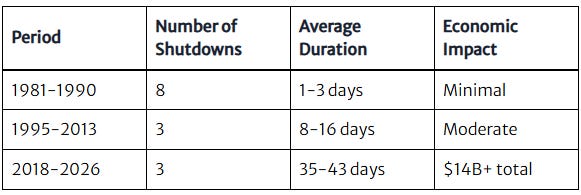
1981-1990: Eight shutdowns during the Reagan and first Bush administrations, most lasting only 1-3 days.
1995-1996: Two shutdowns totaling 26 days during the Clinton administration, as Republicans and Democrats battled over spending levels.
2013: A 16-day shutdown over Affordable Care Act funding, the first major shutdown in nearly two decades.
2018-2019: A 35-day partial shutdown—then the longest in history—over border wall funding.
2025: A 43-day shutdown over healthcare subsidies, shattering all previous records.
2026: Another partial shutdown, this time over immigration enforcement and DHS funding.
Look at the pattern: shutdowns used to be measured in hours or days. Now they’re measured in weeks. What was once a rare procedural accident has become a recurring weapon in partisan warfare.
The Congressional Research Service notes that continuing resolutions, temporary funding measures that were supposed to be emergency stopgaps, have now become standard legislative practice. Congress no longer passes regular budgets. It lurches from crisis to crisis, using the threat of shutdown as a negotiating tool.
This isn’t governing. This is hostage-taking with a 343-million-person hostage pool.
It’s The Two-Party Déjà Vu Dance
Here’s what will happen after this shutdown ends: Democrats will blame Republicans for chaos and dysfunction. Republicans will blame Democrats for unreasonable demands and partisan obstruction. Both sides will claim victory when the government finally reopens. Cable news will move on to the next crisis.
And in six months, or a year, we’ll do it all over again.
Why? Because the shutdown cycle isn’t a bug, it’s the inevitable outcome when both political parties abandon the center and migrate to their ideological extremes.
This wasn’t a structural problem. It was a choice. And it’s getting worse.
Money is the Big Divide
This wasn’t always the case. Up until the late 1960s, American political parties were genuine coalitions. Local Democratic and Republican clubs recruited candidates from their neighborhoods. Party leadership came from the political middle, where consensus could be built. Moderate Republicans and moderate Democrats controlled the process, and legislation happened through negotiation.
Then special interest money changed everything.
Beginning in the 1970s and accelerating dramatically after the Supreme Court’s Citizens United decision in 2010, unlimited money poured into politics, but not to support centrists and consensus-builders. Wealthy donors and ideological foundations funded their allies: immigration hardliners on the right, climate absolutists on the left, anti-tax billionaires funding Republicans, maximum-government advocates funding Democrats.
These donors didn’t want compromise. They wanted total victory on their single issue. They demanded ideological purity, not bipartisan pragmatism. The result: Both parties migrated toward their extremes simultaneously, abandoning the center where Congress used to operate.
This movement to the extremes created a cascade of dysfunctions:
Polarization: When both parties abandoned the center, they stopped viewing each other as loyal opponents and started viewing each other as existential threats. Compromise became politically impossible.
Primary warfare: Donors poured money into primary challenges against centrist incumbents. Candidates learned that ideological purity, not problem-solving, was rewarded with funding. The center became a graveyard of primary defeats.
Procedural weaponization: The filibuster, once rare, became routine. Not because procedures changed, but because the underlying positions became irreconcilable. You can’t compromise between maximum government control and zero regulation.
Presidential power expansion: As Congress became paralyzed, presidents from both parties filled the void with executive orders. They didn’t choose to govern unilaterally, Congress simply couldn’t legislate anymore.
The outcome is what we see today: a Congress that has become institutionally incapable of basic governance, regardless of which party holds the majority.
Crisis is Now Routine
Here’s the pattern most Americans don’t see: Government shutdowns aren’t just happening more often. They’re lasting longer, costing more, and doing permanent damage to federal capacity.
The data reveals an acceleration:
Table: Government Shutdown Frequency and Duration
Each shutdown causes three types of damage:
Immediate economic losses: The 2018-2019 shutdown caused $3 billion in permanent GDP losses. The 2025 shutdown cost $11 billion in lost economic output. These aren’t theoretical numbers, they represent real contracts canceled, real projects delayed, real economic activity that simply never happened.
Federal workforce exodus: Research from American University found that the 2018-2019 shutdown increased federal employee voluntary separations by 19 percent, with quit rates rising 17 percent. The 2025 shutdown accelerated that trend. Longer-tenured employees, the institutional knowledge holders, started leaving at unprecedented rates, recognizing that shutdown-induced chaos had become a permanent feature of federal employment. When you systematically drive talented people out of government through repeated manufactured crises, you don’t just lose productivity in the moment. You lose institutional capacity for years to come.
Institutional capacity erosion: When talented people flee government service, you don’t just lose their current productivity. You lose decades of accumulated expertise. Federal agencies become less capable of executing even basic functions, which creates a feedback loop: dysfunction drives out talent, which increases dysfunction, which drives out more talent.
This acceleration isn’t random. It tracks precisely with the parties’ migration to their extremes. As the distance between them grows, shutdowns last longer because there’s less common ground to negotiate from.
Both Parties Love the Chaos
Here’s the uncomfortable truth about government shutdowns: Both parties have discovered they can benefit from dysfunction, which removes any incentive to prevent the next one.
For Republicans, shutdowns advance a long-term goal: demonstrating that government doesn’t work. When federal agencies shut down and the sky doesn’t immediately fall, it reinforces the narrative that government is bloated and unnecessary. Talented federal workers fleeing the system? That’s not a bug, it’s a feature. A smaller, less capable federal government is exactly what the anti-government wing wants.
For Democrats, shutdowns provide perfect political theater. Republicans always get blamed more heavily by voters. Shutdowns generate sympathetic stories about furloughed workers, delayed benefits, and economic damage. Every shutdown becomes a fundraising opportunity and campaign ammunition: “See what happens when you elect Republicans?”
For both parties’ extreme wings, shutdowns are ideological purity tests. Centrist members who try to negotiate get primaried by ideological purists with deep-pocketed donors. The Tea Party revolutionaries who shut down government in 2013 became heroes to their base. Progressive firebrands who refuse to compromise become social media superstars with millions of followers.
This creates a perverse incentive structure: The members most likely to cause shutdowns face no political consequences within their own parties. They face rewards.
That’s why the shutdown cycle won’t end by itself. The parties have moved so far to their extremes that their activist bases want confrontation more than they want governance. Political scientists call this “affective polarization”, when voters’ emotional hostility toward the other side overwhelms their interest in policy outcomes.
Members of Congress know many of their loyal voters would rather see the government shut down than watch their representative “sell out” by negotiating with the enemy. So they don’t negotiate. They posture, they grandstand, and they wait for the other side to blink first.
And every funding deadline becomes another hostage crisis.
The Centercratic Alternative
The question facing Americans right now isn’t whether this particular shutdown will end. Of course it will. Speaker Johnson will wrangle enough votes, some compromise will emerge, the government will reopen, and both parties will declare victory.
The question is whether we’re ready to break the cycle.
Because here’s what will happen if we don’t: In six months, or a year, there will be another funding deadline. One party will make demands the other refuses to accept. Procedural brinkmanship will escalate. Cable news will cover the countdown to midnight. And once again, the government will shut down, costing billions of dollars, driving talented workers out of public service, and demonstrating to the world that American democracy is broken.
The two-party system cannot fix this problem, because the two-party system is the problem. Both parties are now captured by their ideological extremes. Both punish members who compromise. Both have abandoned the 60 percent of Americans who live in the political center. And both benefit, in different ways, from the chaos: Republicans get to shrink government through attrition, Democrats get to paint Republicans as irresponsible, and neither has to actually govern.
This shutdown isn’t just a political spat; it’s a symptom of systemic failure. And that failure will continue, shutdown after shutdown, crisis after crisis, until we change the structure that creates it.
There is another way.
A genuine third party, a centrist force representing the millions of Americans abandoned by both extremes, would fundamentally change the math. Not overnight. Not perfectly. But it would change the math.
The Centercratic Party exists because we believe Americans are ready. Ready for politics grounded in facts instead of feelings. Ready for leadership that respects intelligence instead of manipulating emotions. Ready for a vision of America that brings us together instead of tearing us apart.
The system is broken, and the two parties are content to leave it that way.
We can accept the dysfunction, or we can finally build the alternative.
The Monday Breakdown is investigative journalism about government failures that mainstream media misses or ignores. We dig into auditor reports, inspector general findings, and data that reveals what’s actually happening in our institutions.