Welcome to Wednesday Insight, where we examine the evidence and historical data to help explain the structural realities of our government.
Here’s a number that should make both political parties nervous:
45 percent.
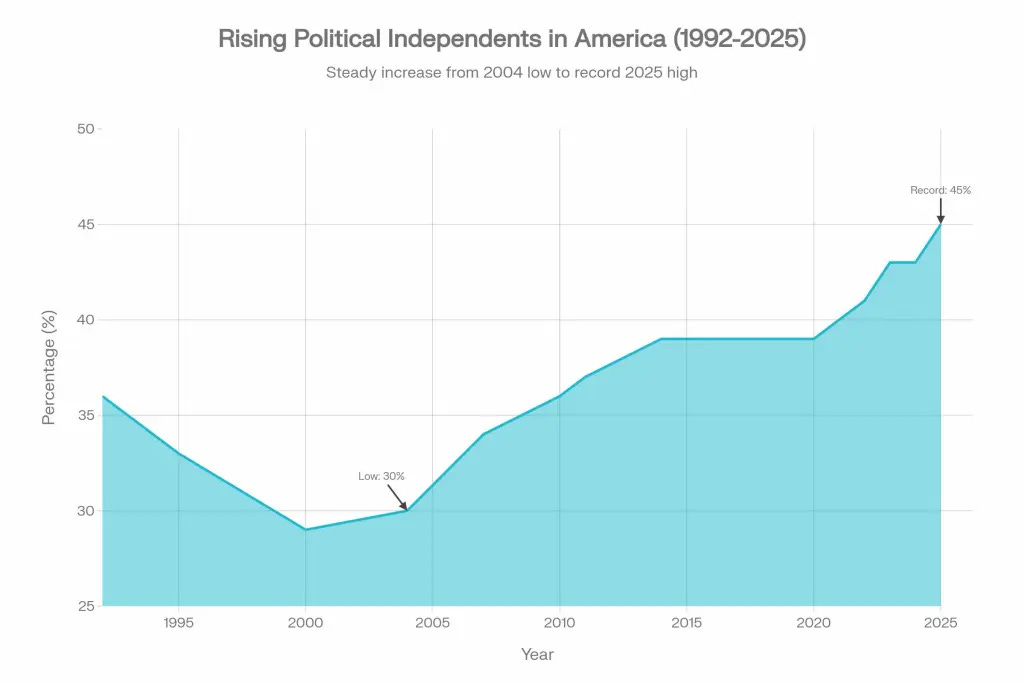
As of 2025, 45% of American adults identify as political independents, neither affiliated with the Democratic nor Republican parties. This marks the highest percentage ever recorded since Gallup began tracking party affiliation in 1988. For comparison, only 27% of Americans identify as Democrats and 27% as Republicans, meaning…
Independents are now the largest political group in America.
This 45% figure comes from Gallup’s annual survey, based on interviews with more than 13,000 U.S. adults throughout 2025. The polling question is straightforward: “In politics, as of today, do you consider yourself a Republican, a Democrat, or an independent?”
As you can see from the above graph, the percentage of Americans identifying as independents has risen from 29% in 2000 to a record 45% in 2025
And yet, there may be no term in American politics more misunderstood than “independent.”
Ask someone what it means, and you’ll get a dozen different answers. Some think it means they vote for the person, not the party. Others believe it signals they’re moderates who reject extremism. And hundreds of thousands of Americans think checking “Independent” on their voter registration form means they’ve declared freedom from partisan politics.
They’re wrong.
The Voter Registration Trap
In 2016, the Los Angeles Times published an investigation that should have sparked a national conversation. The newspaper surveyed voters registered with California’s American Independent Party (AIP) and discovered a stunning fact: 73 percent of them didn’t know they had joined a political party at all. They thought they were registering as independents free from any party affiliation.
The list of accidental AIP members included Demi Moore, Emma Stone, and boxing legend Sugar Ray Leonard, all known Democrats who had contributed to and campaigned for Democratic candidates. Representatives for each celebrity told the newspaper their registrations were mistakes.
How does this happen? California’s voter registration form lists political parties in alphabetical order. The American Independent Party appears first. Voters who think of themselves as “independent” see that name, check the box, and never realize they’ve joined an actual political organization with a specific platform.
If you want to register as truly unaffiliated in California, you have to select “No Party Preference”, bureaucratic language that, as one frustrated voter told the Times, “makes you seem like a disengaged voter.”
This isn’t just a California problem. Across the country, states use different terms: “Independent,” “Unaffiliated,” “No Party Preference,” “Decline to State”, creating a patchwork of confusion that leaves voters unsure what any of it actually means.
A Party Born from Segregation
The American Independent Party itself has a complicated history that most of its accidental members would find troubling.
The AIP was founded in 1967 for one purpose: to put Alabama Governor George Wallace on the California ballot for president. Wallace, a Democrat, had gained national notoriety for his staunch opposition to desegregation. His 1963 inaugural address, written by a member of the Ku Klux Klan, included the infamous declaration: “Segregation now, segregation tomorrow, segregation forever.”
Wallace’s 1968 presidential campaign, run under the American Independent Party banner, was built on “law and order” rhetoric that appealed to white voters angry about the civil rights movement. He won 13.5 percent of the national popular vote and carried five Southern states, earning 46 electoral votes, the strongest third-party presidential performance in the last half-century.
After Wallace, the party fractured and faded from relevance, becoming what the Times called “largely invisible from most campaigns.” Today, the AIP still exists in California, billing itself as “the fastest growing political party” in the state, a claim built largely on the confusion of voters who don’t know they’ve joined.
So when you hear someone say, “I registered as Independent,” they might mean any of several things: a genuine desire to remain unaffiliated, an accidental membership in the American Independent Party, or simply a belief that “independent” describes how they think about politics rather than their official registration status.
Why 45% Are Walking Away
The confusion around registration, however, masks something more significant: a genuine exodus from the two-party system.
Fifty years ago, most Americans held centrist political views. Both parties maintained moderate positions, and major legislation—the Great Society programs, the Voting Rights Act, environmental protections—passed with bipartisan support. Being a Democrat or Republican meant something different than it does today.
Then the parties began to change.
According to the Pew Research Center, Democrats and Republicans in Congress are now farther apart ideologically than at any point in the last 50 years. Political scientists measuring congressional voting patterns have found that polarization today rivals levels not seen since the Reconstruction Era following the Civil War.
This transformation wasn’t accidental. Beginning in the 1970s, Southern Democrats increasingly shifted to the Republican Party, while moderate Republicans in the Northeast moved toward Democrats. The parties sorted themselves ideologically, with conservatives consolidating in one party and liberals in the other.
The result? A “huge gulf in the middle” that neither party is willing to occupy. As one researcher at USC noted, polarization has “inhibited the ability for the two-party system to function.”
Americans have responded by abandoning party labels entirely. The share of independent voters has risen from roughly one-third in the early 2000s to 45 percent today. Among voters under 30, over half now identify as independents, suggesting this trend will only accelerate.
And contrary to the stereotype of independents as disengaged or uninformed, Gallup found that 47 percent of independents describe themselves as “moderates”, a share that has grown as both major parties have moved toward their extremes.
Locked Out of Democracy
Here’s the cruel irony: While independent voters now constitute the largest segment of the American electorate, they often have the least say in choosing their representatives.
Across the United States, 15 states hold closed primaries for congressional elections, and 22 states do so for presidential primaries. In these states, voters who register as independent—truly unaffiliated, not members of the AIP, cannot participate in either party’s primary.
This matters because in today’s gerrymandered political landscape, the real election often happens in the primary, not the general. In “safe” districts where one party dominates, whoever wins the primary will almost certainly win the general election. In 2024, just 7 percent of voters effectively decided 87 percent of U.S. House races through primaries held in these uncompetitive districts.
The 23.5 million independent voters excluded from these primaries have no voice in selecting the candidates who will represent them.
When surveyed, independent voters explain their decision to avoid party membership in clear terms: 31 percent say none of the major parties represents their views. A striking 68 percent say their independent status reflects a desire to “think for myself, independent of what parties and candidates tell me to think.”
These are not disengaged citizens. These are voters actively rejecting a system that no longer speaks for them.
What Independents Want
The data on independent voters reveals something the major parties prefer to ignore: most independents aren’t ideologically extreme. They’re practical, issue-focused, and open to both parties’ positions depending on the topic.
Research shows independents favor Democrats on issues like abortion, healthcare, and climate change, but prefer Republicans on crime, the economy, gun rights, and immigration. They split evenly on infrastructure and are closely divided on foreign policy and gun violence.
In other words, independent voters evaluate each issue on its merits rather than following a party line. They want solutions that work, not ideological purity.
This is precisely the space the major parties have vacated. As polarization has increased, moderates have become unwelcome in both parties. The incentive structure rewards extreme positions that energize the base, not pragmatic policies that might attract the middle.
The result is a Congress that went from enacting 900+ laws per session in the 1950s to just 64 in 2025, a 93 percent decline in legislative productivity. Problems don’t get solved. Dysfunction becomes the norm. And 45 percent of Americans are left wondering whether there’s any political home for them at all.
There is.
The Centercratic Party exists precisely because tens of millions of Americans—whether they call themselves independents, moderates, or simply exhausted—are ready for something different.
Our principles align with what independent voters have been saying for decades: debate with facts and dignity, seek unity through broad support, govern with a balanced approach, and develop policies that build long-term national consensus rather than short-term partisan advantage.
We believe democracy means compromise. It means accepting partial wins and losses rather than demanding total victory. It means protecting the Constitution for everyone, not weaponizing it for one side.
Independent voters aren’t looking for another party that tells them what to think. They’re looking for a political movement that trusts them to think for themselves—and then actually implements the practical, evidence-based solutions that result.
That’s what the Centercratic Party offers.
If you’ve spent years registering as “Independent” or “No Party Preference” because neither major party represents your values, you’re not alone. You’re part of the largest political movement in America—even if no one has organized it yet.
Until now.
About the Author
Paul J. Chapman is the founder and Executive Director of the Centercratic Party. Visit centercratic.party to read the party’s governing principles and policy analyses. Subscribe to The Center Voter at centervoter.com for daily news and weekly policy analysis.
Thank you for reading this edition of Wednesday Insight. Each week, we deliver research and insights by getting underneath American politics to look at it from a completely different angle. We dive into historical data to uncover hidden trends and step back to observe the predictable patterns of wrongness that everyone else accepts as normal. Instead of looking for villains or assuming malicious intent, we act as investigators who ask the quiet questions and follow the evidence to understand exactly how the machinery of our political system actually operates.