


Of the 435 seats in the U.S. House of Representatives, only 36 will be genuinely contested this November. The other 399 were decided long before any ballot is cast. This is the story of how American elections stopped being elections.
How We Lost the Center
In 1997, the Cook Political Report published its first Partisan Voting Index, a tool designed to measure how every congressional district in the country leans relative to the national average. That year, 164 House districts fell in the swing range of D+5 to R+5. Those 164 seats were the center of American politics. They were the districts where elections were actually decided by persuasion, where candidates had to earn votes from both sides, and where the outcome on Election Day was genuinely uncertain.1
That center has been collapsing ever since. By 2017, the number of swing districts had fallen to just 72, a 56 percent decline in two decades. A modest recovery brought the count back to 97 by 2025, driven partly by redistricting reform in states like California, Michigan, and Colorado. But even at 97, the swing seat count sits 41 percent below where it started.2
The decline of crossover voting tells the same story from a different angle. In 1996, there were 115 congressional districts where voters chose a presidential candidate from one party and a House member from the other. By 2024, that number had dropped to 16. That is an 86 percent decline. The American voter who splits a ticket, who judges candidates on their merits rather than their party label, has become nearly extinct.3
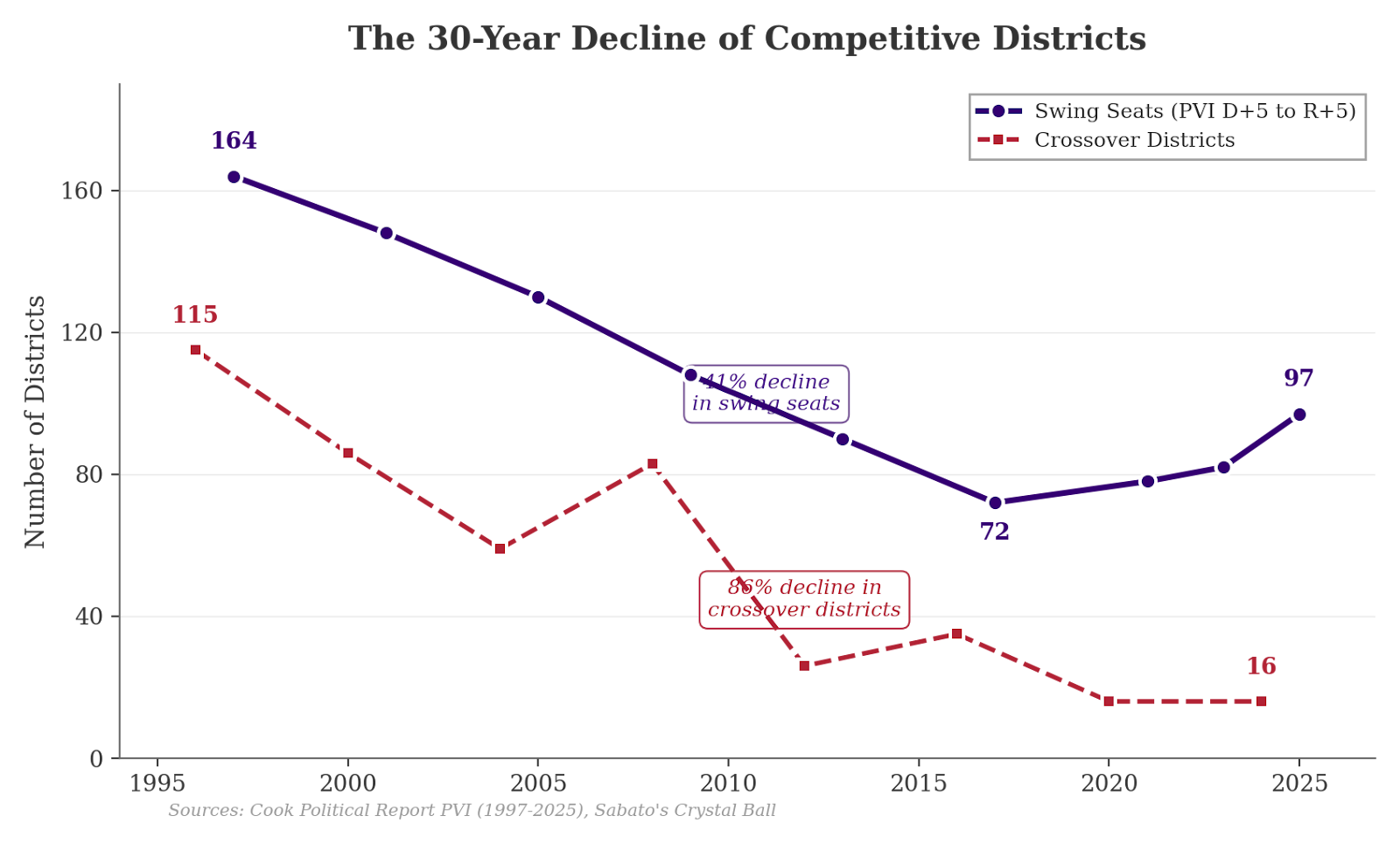
The causes are well documented. The Cook Political Report found that roughly 83 percent of the swing seat decline resulted from natural geographic self-sorting, Americans clustering into communities of like-minded neighbors, while only about 17 percent came from deliberate gerrymandering.4 But gerrymandering amplified the damage. When partisan mapmakers in states like Texas, Ohio, and North Carolina draw boundaries, they transform districts that might otherwise be competitive into safe seats. The mid-decade redistricting cycle that began in 2025 further reduced the competitive zone.5
The result is a House of Representatives where the typical Democrat and the typical Republican represent constituencies that are dramatically more partisan than they were a generation ago. In 1997, the median Democratic-held seat had a Cook PVI of D+7, and the median Republican-held seat had a PVI of R+7, a 14-point gap. By 2017, those figures had shifted to D+14 and R+11, a 25-point gap. Members in those kinds of districts have no electoral incentive to compromise with the other side, and most of them do not.6
The 36-Seat Election
The Cook Political Report’s March 2026 ratings break the 435-seat House into tiers. There are 174 Solid Democratic seats and 183 Solid Republican seats. There are 19 Likely Democratic seats and 8 Likely Republican seats, categories that resolve in the favored party’s direction more than 97 percent of the time. Then there are 16 Lean Democratic, 16 Lean Republican, and 19 Toss Up seats.7
Add it up, and only 36 seats qualify as genuinely competitive. Thirty-two states have zero competitive races. David Wasserman, senior elections analyst for Cook, put it this way in February: “Currently, we only classify 18 out of 435 races as toss-ups, indicating that fewer than 5 percent of Americans will genuinely influence who controls the House.”8 FairVote’s Monopoly Politics 2026 report projects that 81 percent of House seats are already safe for one party, with outcomes effectively decided in primary elections rather than general elections.9
To understand what that means in practice, consider five scenarios for November, ranging from a Republican wave to a Democratic wave. Across all five, the total range of outcomes is just 51 seats. Democrats could win as few as 195 seats in a Republican landslide or as many as 246 in a Democratic surge. The median outcome, based on current forecasting consensus, points to approximately 218 Democratic seats, the barest possible majority.10
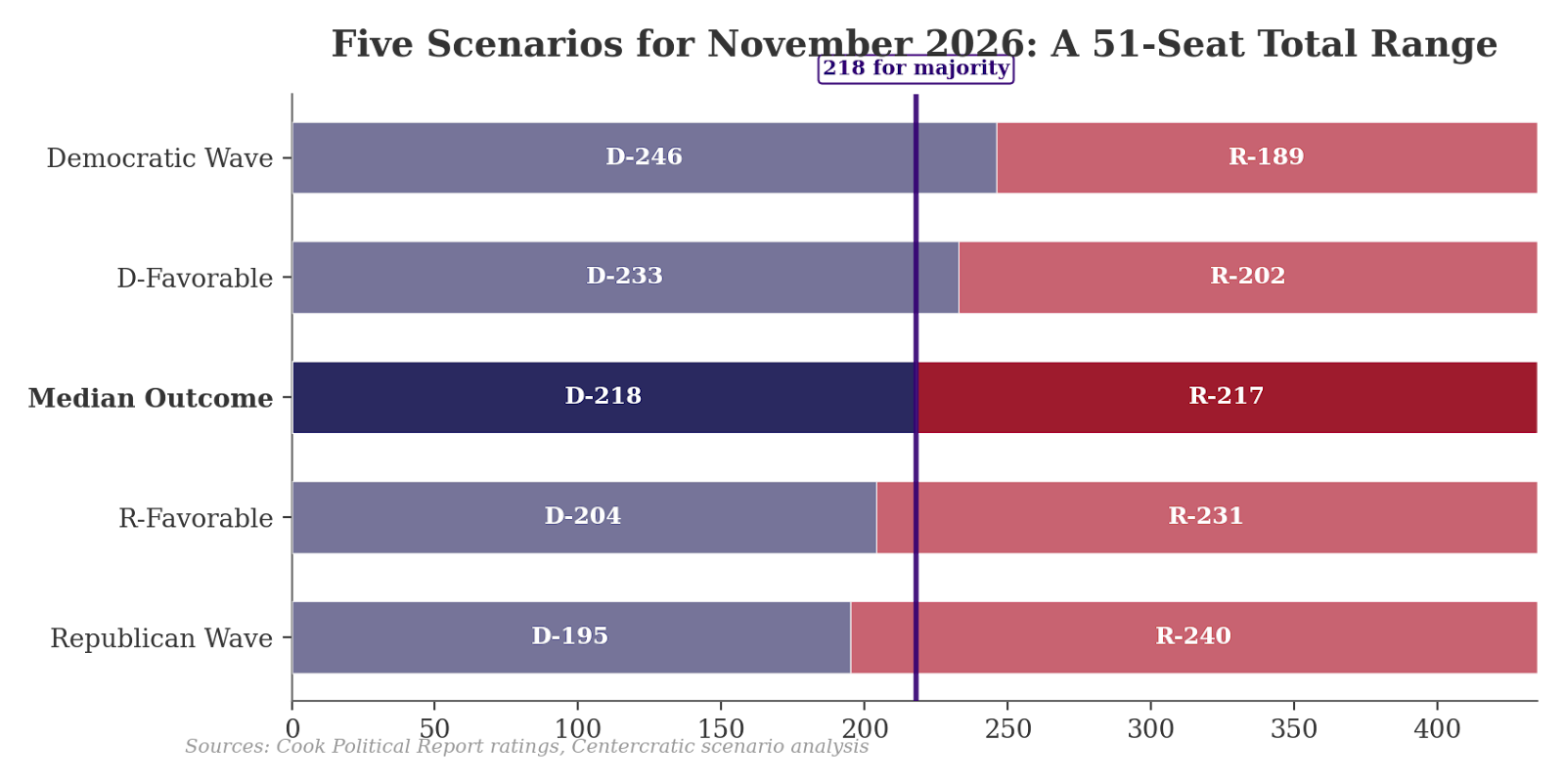
Here is the historical context that makes those numbers remarkable. The 1994 Republican Revolution produced a 54-seat swing. The 2010 Tea Party wave produced a 63-seat swing. Neither of those outcomes would be structurally possible in 2026, because there simply are not enough competitive seats for that kind of movement. The era of the wave election, the kind that produces genuine mandates and realigns the balance of power, is over. It did not end because voters stopped caring. It ended because the playing field was engineered to prevent it.
The Leverage No One Is Talking About
There is a structural consequence of the narrowing battlefield that almost no one in Washington is talking about, and it is the most important finding in this analysis. As the number of competitive seats shrinks, the leverage of a small centrist bloc grows in direct proportion.
Think of it this way. When 90 or 100 House seats were competitive, as they were in 2006 or 2010, the majority party could afford internal dissent. A bloc of 3 or 5 members refusing to vote with their party was a nuisance, not a crisis. The majority had a cushion of dozens of seats. But when only 36 seats are competitive and the likely majority margin is between 1 and 5 seats, those same 3 to 5 members become the most powerful people in the chamber. They hold the deciding votes on every piece of legislation.
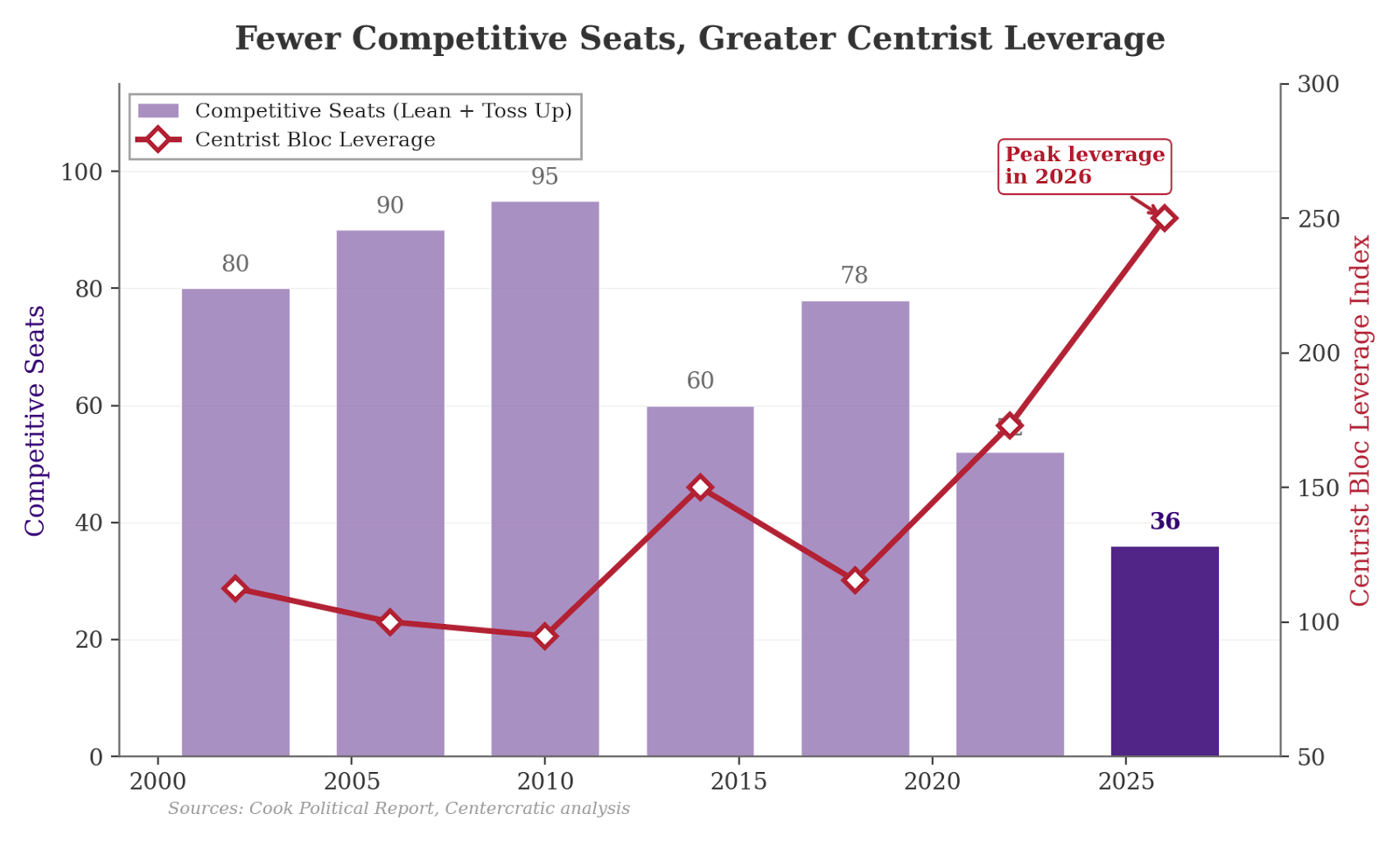
The current Congress has already demonstrated this dynamic. Republicans hold a 219 to 212 majority with 4 vacancies. That margin is so thin that a handful of defections can block any bill, and they have, repeatedly. The next Congress, whether controlled by Democrats or Republicans, will face the same arithmetic. A majority of 218 to 217, which is the median forecast, means that a single member can bring the legislative process to a halt, and a bloc of 3 to 5 centrist members could force both parties to the negotiating table on every major vote.11
This is the inverse curve. As competitive seats decrease, the strategic value of each one increases. As the majority margin shrinks, the power of a disciplined swing bloc grows exponentially. The structural forces that created polarization and gridlock have simultaneously created the conditions under which a small, strategically placed centrist group would wield outsized influence over the legislative process.
A System That Needs a Structural Answer
The story told by three decades of data is not complicated. The two major parties, through a combination of geographic sorting, gerrymandering, and the nationalization of politics, have engineered a House of Representatives where over 86 percent of seats are decided before the general election even takes place. The competitive battlefield has shrunk by more than 40 percent in a single generation. Crossover voting has nearly vanished. And the elections that remain are fought over such a small number of seats that the outcomes are structurally compressed into a narrow band that guarantees continued gridlock regardless of which party wins.
This is not a system that an election can fix. Electing more Democrats will not fix it. Electing more Republicans will not fix it. The structural reality is that neither party can win a large enough majority to govern effectively, and neither party has demonstrated the ability to compromise across the aisle when they hold a narrow one.
What the system needs is a structural alternative. Not a third party that tries to win 218 seats. Not a protest movement that elects a handful of members and then watches them get absorbed into one of the two caucuses. What it needs is a disciplined, strategically placed centrist bloc that targets the handful of genuinely competitive districts where a moderate candidate can win, and then uses that small group of seats to break the legislative deadlock by demanding that both parties negotiate in order to pass anything at all.
That is the purpose the Centercratic Party was built to serve. Not to replace the two major parties, but to force them to work together in a system they have designed to prevent exactly that. The data shows it can work. The arithmetic of a closely divided House, where the majority margin may be 1 to 5 seats, makes it not just possible but practical. The 36 competitive seats identified in the Cook ratings are the universe of opportunity. Within that universe, a targeted strategy focused on 5 to 10 carefully chosen districts is all it would take to change the way Congress operates.12
The narrowing of the battlefield is not something to fear. It is something to use. The same forces that created the problem have, by accident, created the opening for a solution. The question is whether anyone is willing to walk through it.
◆
References
Cook Political Report, Partisan Voting Index historical editions (1997-2025), https://www.cookpolitical.com/cook-pvi
Cook Political Report, Partisan Voting Index historical editions (1997-2025), https://www.cookpolitical.com/cook-pvi
Sabato’s Crystal Ball, University of Virginia Center for Politics, https://centerforpolitics.org/crystalball/
Cook Political Report, Partisan Voting Index historical editions (1997-2025), https://www.cookpolitical.com/cook-pvi
Brennan Center for Justice, redistricting analysis, https://www.brennancenter.org/our-work/research-reports/redistricting
Cook Political Report, Partisan Voting Index historical editions (1997-2025), https://www.cookpolitical.com/cook-pvi
Cook Political Report, March 12, 2026 House Race Ratings, https://www.cookpolitical.com/ratings/house-race-ratings
David Wasserman, NPR, February 2026, https://www.npr.org/2026/02/19/nx-s1-5267889/competitive-house-races-midterms-2026
FairVote, Monopoly Politics 2026, https://fairvote.org/report/monopoly-politics-2026/
Race to the White House 2026 House forecast, https://www.racetothewh.com/house
Race to the White House 2026 House forecast, https://www.racetothewh.com/house
Cook Political Report, March 12, 2026 House Race Ratings, https://www.cookpolitical.com/ratings/house-race-ratings