


Marcus Webb spent 19 years as a training coordinator at the U.S. Agency for International Development, the federal foreign aid office that delivered food, vaccines, and disaster relief to more than 100 countries. He built curricula, managed contractors, and mentored younger colleagues who believed, as he did, that what they did every day saved lives. On July 1, 2025, the agency was formally closed. His office was gone. The programs he managed were gone. The FBI moved into the building.
Webb’s story is not unusual. It is, in fact, entirely predictable. Not because of some last-minute political decision, but because someone wrote it down two years earlier, in a 920-page document called Project 2025, and meant every word of it.
Here is what most Americans do not yet understand: Project 2025 was not a wish list. It was a construction plan. And as of this week, independent trackers confirm that between 51 and 53 percent of its proposals have been initiated or completed, representing the fastest restructuring of the federal government in modern American history. The debate happening in Washington right now is mostly about the half that has not yet been done. The half that is already done barely gets mentioned.
The Disavowal That Wasn’t
When reporters first pressed Donald Trump about Project 2025 during the 2024 campaign, his answer was consistent: he had never read it, had nothing to do with it, and disagreed with some of its ideas. The Heritage Foundation, sensing that the document had become a political liability, removed its director in August 2024 and publicly distanced itself from the project.
The document itself never went anywhere. Published in April 2023, it had been drafted by more than 400 conservative scholars and former government officials from over 100 organizations. Its core argument was straightforward: a second Trump term would have a four-year window to fundamentally restructure the executive branch, and if that window was not used aggressively from the very first day, it would be wasted. The document described, chapter by chapter, exactly how to use it.
In Trump’s first week back in office, more than two-thirds of his executive actions tracked directly to Project 2025 proposals. The administration signed more than 225 executive orders in 2025 alone, a volume unmatched in modern presidential history.¹ The disavowal had been a campaign strategy. The document had been a governing one.
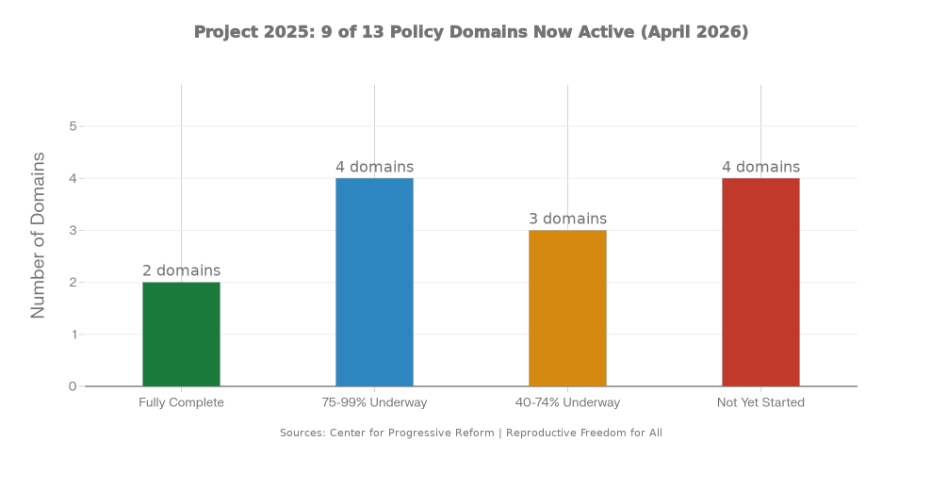
As you can see from the chart below, 9 of the 13 policy domains are either fully complete or well underway.
What They Actually Built
The most complete implementation is the one that received the least sustained public attention. On March 8, 2026, a federal rule known as Schedule Policy/Career took full effect. It stripped civil service protections from approximately 50,000 federal employees, converting them to at-will workers who can be fired for what the rule calls ‘subversion of presidential directives,’ with no right to appeal to an independent watchdog. More than 260,000 federal workers left government service in 2025 through layoffs, forced retirements, and resignations, representing roughly 9 percent of the entire civilian federal workforce.² That is not a reorganization. It is a generational transformation of how the government operates.
USAID is gone. The agency that delivered humanitarian aid to more than 100 countries, managed more than $120 billion in contracts at the start of 2025, and employed thousands of Americans like Marcus Webb was formally shuttered on July 1, 2025. A Lancet study estimated the funding cuts could contribute to 14 million additional deaths worldwide, including 4.5 million children. The FBI now occupies USAID’s former headquarters in Washington.³ Rebuilding that agency would require an act of Congress, years of institutional reconstruction, and a level of political will that has rarely existed in Washington under any party.
More than 8,000 federal web pages and 3,000 government datasets have been removed from public access, including nearly all climate science resources maintained by federal agencies.⁴ All 400 scientists working on the congressionally mandated 2027 National Climate Assessment were dismissed. The entire climate.gov staff was let go on May 31, 2025. Those scientists are not returning. Those datasets are not being rebuilt. This is what the word ‘permanent’ means when applied to government action.
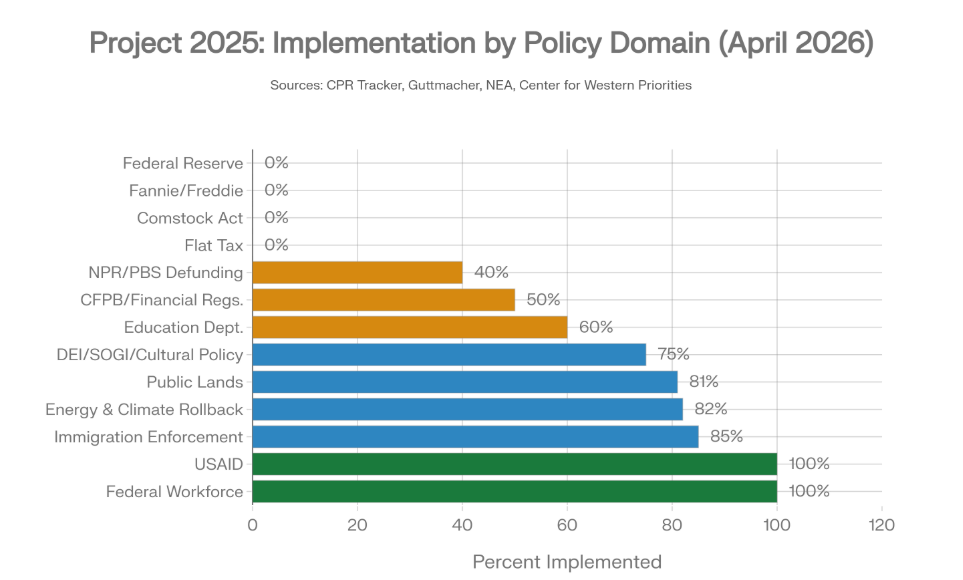
The chart below details the status of the nine active policy domains.
What the Courts Have to Say
The administration has not had everything go its way. By March 31, 2025, 152 lawsuits had been filed to block Project 2025-aligned executive actions, and the administration lost approximately 93 percent of those early cases.⁵ Courts have blocked funding cutoffs to sanctuary cities, reinstated employees at the Consumer Financial Protection Bureau after DOGE shut it down, and issued injunctions against multiple immigration enforcement tactics.
The legal picture is now converging on the Supreme Court, where two cases expected to be decided by August 2026 could determine the trajectory of everything still on the Project 2025 agenda. One involves birthright citizenship, a right guaranteed by the 14th Amendment that the administration has tried to limit by executive order. The other is a broader challenge about how much direct control a president can exercise over independent federal agencies, a legal theory known as the unitary executive doctrine. If the Court rules in the administration’s favor on that second case, many of the proposals that courts have blocked could move forward without any need for Congress to act.
The Half That Hasn’t Happened Yet
The 48 percent of Project 2025 that remains unimplemented is concentrated in proposals that require legislation. A two-tiered flat income tax replacing the current progressive system has not been introduced. The statutory abolition of the Department of Education, which requires a 60-vote Senate supermajority, has not advanced beyond executive hollowing-out. The Comstock Act, a 19th-century anti-obscenity law that Project 2025 proposed using to ban the mailing of contraception and abortion medication nationwide, has not been enforced in that way. Fannie Mae and Freddie Mac, the government-backed mortgage companies that Project 2025 wants privatized, remain under federal control.
These proposals hit a wall that Project 2025’s authors acknowledged but perhaps underestimated: Congress. Republicans hold a 218-214 majority in the House, meaning a single defection on any party-line vote can kill legislation. The Senate requires 60 votes to overcome a procedural delay called a filibuster on most bills, and Republicans do not have them. The entire Congress passed just 64 bills in all of 2025, a 93 percent drop from mid-20th-century legislative productivity.⁶ The legislative half of Project 2025 is waiting for a Congress that does not yet exist.
The Plan That Dares Not Speak Its Name
There is one detail about Project 2025 that its own architects find embarrassing. In polling conducted in late 2025, the name “Project 2025” registered just 7 percent favorable among Republican voters, despite the fact that its policies were being actively implemented by a Republican administration. Heritage Foundation President Kevin Roberts responded the way any organization would respond to a branding problem: he changed the name. At Turning Point USA’s AmFest conference in December 2025, Roberts unveiled Heritage 2.0, built around four new pillars: The American Family, The Dignity of Work, National Security, and American Heritage and Citizenship. The policy agenda behind those pillars is identical to the document the administration spent the campaign denying it had ever read.⁷
Roberts was not alone in the room, but he was increasingly alone in the movement. More than 60 senior Heritage figures, including trustees and scholars who had co-written Project 2025, resigned by January 2026. Legal scholar Robert P. George departed. Staff member Josh Blackman wrote that he was leaving because of what he called a rising tide of antisemitism on the right. National Review published a piece under the headline: ‘The Heritage Foundation Implodes.’⁸ The institution that built the blueprint was fracturing even as the blueprint was being built out.
The Question Nobody Is Asking
The conversation in Washington, and in most American living rooms, treats Project 2025 as a future threat, something that could happen if the right elections go the wrong way. That conversation is 15 months out of date. The more consequential question is not what Project 2025 might still do. It is what has already been done, what cannot be undone, and whether the American public understands the difference.
USAID requires an act of Congress to rebuild. The 260,000 federal workers who left government service took decades of institutional knowledge with them that no hiring freeze reversal can restore. The climate scientists dismissed from the National Climate Assessment are working elsewhere. The deleted datasets are gone. These are not policy positions that change with the next election. They are structural changes to how the country functions, and they were executed with a speed and completeness that most Americans never saw coming, because for most of the campaign, both the candidate and the document denied they had anything to do with each other.
Marcus Webb has moved on. He teaches now, at a community college in northern Virginia, training the next generation of public administrators in the theory of government service. He told a former colleague recently that he hopes his students never have to learn the harder lesson he learned: that the most consequential decisions a government makes are often the ones it makes before anyone realizes they are decisions at all.
Shouldn’t We in the Center Be Alarmed?
What Project 2025 proved, above all else, is that a determined political movement with a detailed plan and a four-year window can reshape the architecture of American government faster than most citizens can follow. That is not a partisan observation. It is a structural warning.
The conservative movement built its blueprint in the open, and the country largely missed it until the construction was half finished. There is no reason a future movement from the left could not do exactly the same, using the same tools, the same executive power, and the same speed, in the opposite direction.
In our next article, we will show you exactly what that looks like, walking through a progressive mirror image of Project 2025 proposal by proposal, so you can judge for yourself whether the threat to the center comes from only one direction.
What America is watching right now is not just a conservative project. It is a demonstration of what happens when ideological extremes replace governing with engineering. The antidote is not a counter-blueprint from the other side. It is the kind of steady, accountable, moderate governance that puts the country’s institutions ahead of any party’s agenda, and that begins with an electorate willing to demand it.
That is precisely the ground the Centercratic Party was built to hold.
Sources
1. Federal Register, Presidential Documents, Executive Orders, Donald Trump 2025. federalregister[dot]gov/presidential-documents/executive-orders/donald-trump/2025. CNN analysis: over two-thirds of first-week actions mirror Project 2025. morolawyers[dot]com/post/project-2025-implementation-under-president-trump-status-as-of-march-1-2025
2. Schedule Policy/Career final rule, NPR, February 6, 2026. npr[dot]org/2026/02/06/nx-s1-5704171/trump-fire-federal-employees-schedule-f. Federal workforce departures: ABC News, 2025. abcnews[dot]com/US/wireStory/year-after-trumps-doge-cuts-workers-lives-upended-131464633
3. USAID official closure, NPR, July 1, 2025. npr[dot]org/2025/07/01/nx-s1-5451372/usaid-officially-shuts-down-and-merges-remaining-operations-with-state-department. Lancet study estimates. DonorTracker. donortracker[dot]org/policy_updates?policy=us-government-announces-official-closure-of-usaid-2025
4. Federal web pages and datasets removed, Wikipedia. en.wikipedia[dot]org/wiki/2025_United_States_government_online_resource_removals. Climate scientists dismissed: Center for Western Priorities. westernpriorities[dot]org/2026/01/from-disavowal-to-delivery
5. 152 lawsuits filed by March 31, 2025. Fullerton Observer. fullertonobserver[dot]com/2025/03/31/doge-trump-project-2025-blocked-by-152-lawsuits-in-just-three-months
6. 64 bills enacted in 2025. GovTrack / Congress[dot]gov. GOP House majority 218-214: Associated Press, January 2025.
7. Project 2025 polls at 7% favorable among Republicans; Heritage 2.0 launched December 2025. The Independent. independent[dot]co[dot]uk/news/world/americas/us-politics/trump-project-2026-heritage-foundation-b2894824.html
8. 60+ Heritage resignations: Washington Informer. washingtoninformer[dot]com/heritage-foundation-resigns-project2025. ‘The Heritage Foundation Implodes’: National Review, via The Advocate. advocate[dot]com/politics/project-2025-continues-into-2026