Welcome to Wednesday Insight, where we examine the evidence and historical data to help explain the structural realities of our government.
Editorial Note: This is a thought experiment. Just as Project 2025 represented the fringe right, not mainstream conservatism this document imagines what the equivalent fringe left would look like if organized with the same ambition, institutional backing, and ideological maximalism. It is not an endorsement of any of these positions; it is a mirror.
Overview
Project 2025 was built on four pillars: a comprehensive policy document (Mandate for Leadership), a personnel recruitment pipeline filtered by ideology, a training academy for “loyalists,” and a 180-day agency-by-agency playbook. A progressive equivalent, call it Project 2028: Mandate for the People, would mirror all four pillars, replacing Heritage Foundation conservatism with the maximalist left’s governing vision.[1]
Where Project 2025 sought to dismantle the administrative state and concentrate executive power in a ideologically loyal president, Project 2028 would seek to massively expand the state, redistribute wealth and power, and embed progressive ideological loyalty throughout the federal bureaucracy in the opposite direction.[2][3]
The organizing bodies would likely be a coalition of groups such as the Congressional Progressive Caucus, Justice Democrats, Sunrise Movement, DSA (Democratic Socialists of America), and unions like the AFL-CIO and SEIU, analogous to Heritage Foundation’s 100+ partner organizations. AOC, who is currently at the center of the progressive wing’s 2028 energy, and figures like Bernie Sanders would serve as the ideological architects, just as Kevin Roberts and Paul Dans did for Heritage. [1][4][5][6]
The Four Pillars
Pillar 1: The Policy Document — Mandate for the People
A 900+ page document, organized around these core principles (directly mirroring Project 2025’s pillars):[7]
Restore the working class as the centerpiece of American life (mirroring “restore the family”)
Build and expand the administrative state (the direct opposite of “dismantle the administrative state”)
Defend the nation’s resources and people against corporate and oligarchic power (mirroring “defend sovereignty”)
Guarantee equality of outcomes, not just opportunity (mirroring “take our culture back”)
Pillar 2: Loyalty-Tested Personnel
Project 2025 built a database of pre-vetted conservative loyalists to replace 50,000 career civil servants with ideologically committed replacements. Project 2028’s equivalent would:[3][1]
Recruit progressive organizers, union leaders, climate scientists, and social justice advocates for every agency
Screen candidates for ideological alignment with progressive principles
Use Justice Democrats’ and Our Revolution’s networks to build a parallel staffing pipeline, mirroring Heritage’s “Presidential Administration Academy”[1]
Pillar 3: The Progressive Administration Academy
An online training program (mirroring Heritage’s indoctrination academy) to prepare progressive appointees, covering:[1]
Labor and workers’ rights law
Environmental justice frameworks
Anti-monopoly and antitrust theory
Racial equity and reparations implementation
Pillar 4: The 180-Day Playbook
Agency-by-agency action items executable on Day One. The progressive answer to Project 2025’s 180-day transition plan.[1]
Policy Agenda by Chapter
The following mirrors Project 2025’s chapter structure, but with maximalist left-wing policy:[8]
Chapter 1: The Executive Office Centralizing Progressive Power
Just as Project 2025 sought to pack the White House with loyalists and expand presidential authority, Project 2028 would:[2][3]
Eliminate the Office of Management and Budget’s budget-cutting function; replace it with a National Planning Council modeled on the Nordic administrative state
Create a new White House Office of Inequality Reduction with cabinet-level authority
Appoint progressive economists and union leaders to every economic advisory body
Issue Day One executive orders restoring and vastly expanding all protections rolled back under Trump 2.0
Chapter 2: Central Personnel — Purging “Corporate Democrats”
Where Project 2025 sought to replace career bureaucrats with conservative loyalists, Project 2028’s Personnel chapter would:[1]
Reverse all Schedule F executive orders and reinstate fired federal employees
Mandate that all senior political appointees come from progressive advocacy backgrounds
Eliminate the revolving door between federal agencies and Wall Street/corporate America
Extend civil service protections to make it harder to fire progressive-aligned workers in the future
Chapter 3: Department of Justice — Prosecuting Oligarchs
Project 2025 sought to weaponize DOJ against political enemies. Project 2028’s DOJ vision would:[7]
Create a dedicated Corporate Crimes Division with a $10B budget to prosecute CEO fraud, wage theft, and environmental crimes
End mass incarceration through wholesale drug decriminalization[9]
Abolish mandatory minimum sentencing
Investigate and potentially prosecute billionaires for alleged market manipulation and tax evasion
End cash bail nationwide via DOJ funding conditions to states
Chapter 4: Defense — Massive Cuts and Reorientation
Project 2025 called for an expanded, ideologically realigned military. Project 2028 calls for the opposite:[10][11][7]
Cut the defense budget by 30–50%, redirecting funds to domestic programs
Close overseas military bases and withdraw from “offensive” NATO commitments
Redirect Pentagon R&D spending to green energy and climate infrastructure
Repeal the Authorization for Use of Military Force (AUMF) and require congressional approval for all military action
Eliminate nuclear weapons production programs
Chapter 5: Department of Homeland Security — Abolish ICE, Restructure DHS
Project 2025 wanted to expand DHS and dramatically accelerate deportations. Project 2028 would go in the opposite direction:[9][2]
Abolish ICE and transfer immigration enforcement functions to a civilian-led bureau under the State Department
Decriminalize unauthorized border crossings, making them civil rather than criminal violations[9]
End all immigration detention without violent criminal conviction
Grant immediate legal status and a path to citizenship for all undocumented residents
Break up DHS itself, distributing its functions across civilian agencies[9]
Chapter 6: Department of State — Anti-Imperialism and Global Justice
Project 2025 pushed for aggressive American unilateralism. Project 2028 would:[7]
Return the U.S. to the Paris Agreement and ratify the UN Convention on the Rights of the Child
Make U.S. foreign aid conditional on recipient countries’ labor rights and environmental records
Cease arms sales to governments committing human rights abuses
Establish a Department of Global Democracy Promotion free of CIA influence
Cancel bilateral trade deals that lack labor and environmental standards
Chapter 7: Department of Health and Human Services — Medicare for All
Project 2025 called for cutting Medicare and Medicaid. Project 2028’s centerpiece would be:[2][7]
Medicare for All: A single-payer system eliminating private health insurance. The Congressional Budget Office and CRFB have estimated this costs $32 trillion over 10 years, requiring either a 32% payroll tax, a 25% income surtax, or doubling all income tax rates[12][13][10]
Nationalize pharmaceutical manufacturing for essential drugs; set prices by congressional mandate
Expand Medicaid to undocumented immigrants
Fund abortion services federally in all states
Mandate free mental health care as a Medicare benefit
Chapter 8: Labor — Maximum Unionization
Project 2025 sought to make union organizing harder and ban public-sector unions. Project 2028’s Labor chapter is the polar opposite:[14][15]
Pass the Workplace Democracy Act: allow unions to organize via majority sign-up, eliminate “right to work” laws, extend union rights to gig and independent workers[15]
Mandate worker representation on corporate boards of all companies with 100+ employees (the German Mitbestimmung model)
Raise the federal minimum wage to $25/hour
Establish a Federal Jobs Guarantee: the federal government as employer of last resort, guaranteeing a $25/hour job to any American who wants one
Reduce the standard workweek to 32 hours with no reduction in pay
Chapter 9: Education — Free College and Abolish Student Debt
Project 2025 sought to abolish the Department of Education entirely. Project 2028 would massively expand it:[2]
Cancel all $1.7 trillion in outstanding student debt[12]
Make public college and university tuition-free
Expand public school budgets by 50% via a federal wealth-tax-funded education endowment
Mandate comprehensive sex education, climate science, and ethnic studies in all public schools
Eliminate private school tax deductions and voucher programs
Chapter 10: Environment — Green New Deal
Project 2025 called for rolling back environmental regulations and withdrawing from international climate agreements. Project 2028’s environmental chapter would cost as much as $16 trillion:[3][12][2]
Implement the full Green New Deal: 100% clean energy by 2035
Create a Civilian Climate Corps of 1 million workers
Ban all new fossil fuel extraction on federal lands
Nationalize the fossil fuel industry’s infrastructure and wind it down under a managed transition
Make the EPA an independent constitutional agency impossible to gut via executive order
Chapter 11: Treasury and Tax — Soak the Rich
Project 2025 pushed for lower taxes, a flat income tax, and corporate tax cuts. Project 2028 goes to the opposite extreme:[16][12][2]
Implement a 2% annual wealth tax on wealth above $50 million, 3% above $1 billion (the Warren Wealth Tax)[16]
Raise the top marginal income tax rate to 70% on income over $10 million
Raise the corporate tax rate to 35%
Create a financial transaction tax of 0.1% on all stock, bond, and derivatives trades
Eliminate the carried interest loophole, step-up basis, and all capital gains preferences
Chapter 12: Housing — Housing as a Right
Project 2025’s HUD chapter called for deregulating housing markets. Project 2028 would:[7]
Declare housing a constitutional right and mandate federal enforcement
Construct 10 million units of public housing over 10 years, funded by the wealth tax
Enact national rent control: limit rent increases to inflation
Create a federal right to counsel for all tenants facing eviction
End exclusionary zoning nationwide via federal funding conditions[13]
Chapter 13: Financial Regulation — Break Up Big Banks
Project 2025 called for weakening the Consumer Financial Protection Bureau and deregulating Wall Street. Project 2028 would:[17][7]
Reinstate and expand Glass-Steagall, separating commercial and investment banking
Break up any bank with assets over $500 billion
Create a U.S. Postal Bank offering free checking and savings accounts to all Americans
Expand the CFPB into a Consumer Financial Protection Agency with rule-making authority over all financial products
Tax stock buybacks at 100% above inflation-adjusted book value
Chapter 14: Commerce and Trade — Anti-Monopoly Enforcement
Project 2025 sought to weaken antitrust enforcement. Project 2028 would:[7]
Enact a presumptive ban on all mergers above $5 billion
Break up Big Tech monopolies (Amazon, Google, Meta, Apple) through aggressive antitrust suits
Create a Department of Economic Democracy to oversee corporate concentration
Bar companies from both owning platforms and competing on them (ending Amazon’s dual role)
Mandate open-source AI models for any AI system trained on public data
Chapter 15: Culture and Social Policy
Project 2025’s “Culture War” chapter targeted LGBTQ+ rights, pornography, and DEI programs. Project 2028’s cultural chapter would:[7][1]
Pass the Equality Act permanently enshrining LGBTQ+ non-discrimination protections[13]
Mandate federal funding for gender-affirming care under Medicare for All[13]
Implement reparations for descendants of enslaved people: a federal commission to determine amount and delivery mechanism
Enact comprehensive police reform: end qualified immunity, mandate body cameras, redirect 10% of local police budgets to community services
Establish Universal Basic Services: free public transit, broadband, and childcare as federal entitlements
Chapter 16: Elections and Democracy
Project 2025 sought to restrict voting access and consolidate Republican electoral power. Project 2028 would:[7]
Enact automatic voter registration for all Americans at age 18
Create a federal public campaign financing system, banning all private donations above $200
Pass the For the People Act (H.R. 1) to nationalize election standards
Abolish the Electoral College via a National Popular Vote compact or constitutional amendment
Expand the Supreme Court to 13 justices and impose 18-year term limits
Grant statehood to Washington D.C. and Puerto Rico
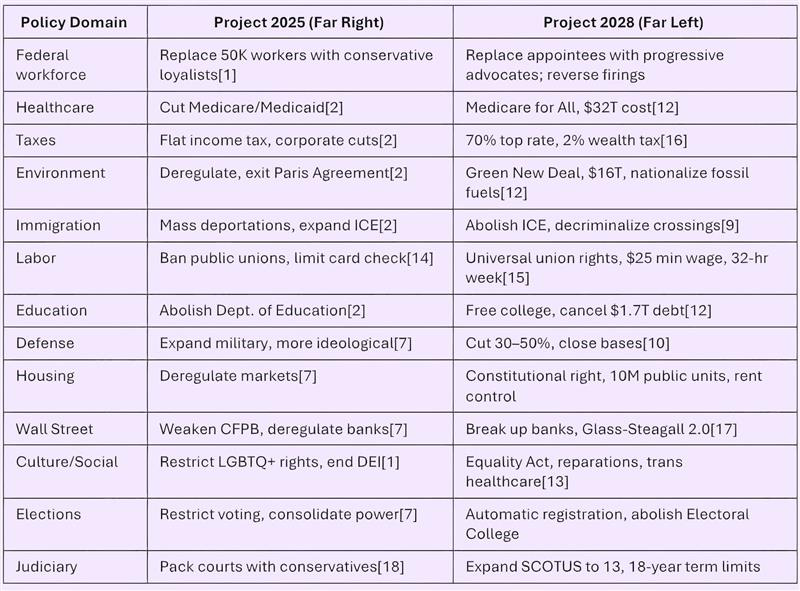
Side-by-Side: Project 2025 vs. Project 2028
Why the Symmetry Is Instructive
The exercise reveals something important: both the far right and the far left share a common structural approach: identify ideological enemies embedded in the existing system, replace them with loyalists, and use executive power to reshape government in the image of the movement’s values. Project 2025 explicitly built a “spoils system” based on ideological tests. Project 2028, as imagined here, would do exactly the same thing in reverse.[1]
Both blueprints also share a weakness: cost and political durability. Project 2025’s proposals have already generated significant public backlash, and the progressive agenda faces even steeper arithmetic challenges. The Committee for a Responsible Federal Budget estimated Medicare for All alone would require a 32% payroll tax; add the Green New Deal ($16T), free college ($3T), housing ($4T+), and a federal jobs guarantee, and the total spending package would dwarf any historical peacetime program.[19][12]
Real-world Democrats in 2026 are debating precisely whether a figure like AOC (whose allies are laying groundwork for a 2028 run) or a centrist like Josh Shapiro or Pete Buttigieg better serves the party’s electability. Third Way and the center-left have explicitly launched a “Stop AOC” effort for 2028, reflecting the same internal tensions that produced the conservative-vs-MAGA split on the right. Thomas Edsall’s New York Times column on a hypothetical “Project 2028” for Democrats took a very different path, explicitly centrist and market-oriented, underscoring that the actual Democratic mainstream is nowhere near the hypothetical maximalism described above.[20][21][22][5][6]
The fringe left version described in this document is thus not a prediction. it is a structural mirror, showing what institutional maximalism looks like when the ideological polarity is reversed.
About the Author
Paul J. Chapman is the founder and Executive Director of the Centercratic Party. Visit centercratic.party to read the party’s governing principles and policy analyses. Subscribe to The Center Voter at centervoter.com for daily news and weekly policy analysis.
Thank you for reading this edition of Wednesday Insight. Each week, we deliver research and insights by getting underneath American politics to look at it from a completely different angle. We dive into historical data to uncover hidden trends and step back to observe the predictable patterns of wrongness that everyone else accepts as normal. Instead of looking for villains or assuming malicious intent, we act as investigators who ask the quiet questions and follow the evidence to understand exactly how the machinery of our political system actually operates.