

Editorial Note: This article examines how the Democratic Party’s platforms have evolved over 48 years: what changed, when it changed, and what that transformation reveals about two-party political incentives. We examine the mechanism of political change, not the merits of any specific policy. This article does not advocate for or against any specific policy outcomes. Its focus is on how the Democratic Party’s policy priorities and rhetorical framing have evolved over time. We encourage our readers to consider: What do you observe in the data? How has politics changed in your experience? What would you prefer? Then visit centercratic.party to explore our actual policy positions.
The Story in the Platforms
There’s a remarkable story hidden in the Democratic Party platforms from 1976 to 2024. It’s not the story Democrats tell themselves. It’s not the story Republicans use to attack them. It’s a story about how a political party, one that once spoke confidently about solving problems and bringing Americans together, gradually transformed into something more defensive, more embattled, and ultimately more hostile.
This isn’t a tale of betrayed values or cynical calculation. It’s something more instructive: how a party can remain remarkably consistent in its core commitments while completely transforming how it talks about those commitments. How economic justice advocacy can shift from aspirational policy-making to defending past achievements. How a party that once acknowledged “no political party possesses answers to all problems” can evolve into one that presents Republicans as existential threats to democracy itself. How the scope of rights can expand dramatically while the space for disagreement shrinks to nearly nothing.
To understand this transformation, we examined five Democratic Party platforms spanning exactly 48 years: 1976, 1988, 2000, 2012, and 2024. Each platform sits precisely 12 years apart, capturing snapshots at regular intervals across nearly half a century of American political evolution. These aren’t campaign promises or stump speeches. These are the formal policy positions, priorities, and framings that Democrats committed to paper every four years at their national convention. Together, these five documents reveal a transformation that most Americans sense but few have clearly documented, until now.
What Never Changed: The Anchors
Before examining what transformed, we must acknowledge what remained remarkably constant. Across 48 years and five platform iterations, the Democratic Party has held unwaveringly to five core commitments:
First, economic justice and full employment. From Carter’s 1976 promise of government “committed to a fairer distribution of wealth, income and power” to Biden’s 2024 pledge to grow the economy “from the bottom up and middle out,” this principle endured. The language evolved, but the fundamental commitment never wavered: government should actively promote economic fairness and opportunity for working Americans.
Second, universal healthcare access. Whether calling for “national health insurance” in 1976 or defending the Affordable Care Act in 2024, Democrats consistently positioned healthcare as a right, not a privilege. The path shifted from aspirational reform to enacted legislation to defensive protection, but the destination remained constant.
Third, investment in public education. Every platform, from every era, treated education funding as both economic necessity and moral imperative. From 1976’s focus on desegregation and equal opportunity to 2024’s emphasis on student debt relief and pandemic recovery, education remained sacrosanct.
Fourth, civil rights and equality. The Democratic commitment to civil rights appears in every platform examined. What changed dramatically was the scope of who received protection and what rights were defended, but the principle that government should actively protect equality never wavered.
Fifth, progressive taxation. From 1976’s call to make “high income citizens pay a reasonable tax on all economic income” to 2024’s demand that the wealthy and corporations “Pay Their Fair Share,” the commitment to tax fairness persisted across five decades.
These anchors matter because they demonstrate something crucial: The Democratic Party didn’t abandon its principles. It remained committed to economic fairness, expanded rights, public investment, and progressive taxation. What transformed was not the destination, but the journey, and most significantly, how Democrats talked about the opposition standing in their way.
Change From Building to Protecting
The most striking evolution in Democratic platforms isn’t about new issues emerging or old issues disappearing. It’s about the shift from aspirational to defensive posturing.
Healthcare: From Vision to Fortress
In 1976, Democrats proposed something bold: “national health insurance with strong built-in cost and quality controls.” The language was confident, forward-looking, focused on building something new. The platform detailed how it would work, acknowledged the complexity, and invited Americans to embrace comprehensive reform.
By 2024, healthcare language had transformed entirely. The platform now defends the Affordable Care Act from “Republican repeal,” promises to “lower prescription drug costs” through Medicare negotiation, and focuses on “protecting” coverage. The 2024 platform doesn’t propose a new healthcare vision; it fortifies an existing one against constant assault.
This pattern repeats across issue after issue:
Reproductive rights: In 1976, Democrats carefully stated it was “undesirable to attempt to amend the U.S. Constitution to overturn the Supreme Court decision” on abortion, a stance that was neutral, procedural, and avoided commitment. By 2024, “Reproductive Freedom” merited its own major section, with explicit commitment to restore Roe v. Wade and defend access against Republican restrictions.
Voting rights: The 1976 platform proposed expanding the franchise and enforcing existing protections. The 2024 platform defends voting rights against “Republican suppression” and frames access to the ballot as under constant threat.
Social programs: Where 1976 proposed “welfare reform” and acknowledged the existing system was “inadequate and wasteful,” 2024 defends social programs against Republican cuts and reframes poverty programs as positive goods, not systems requiring fundamental restructuring.
The rhetorical shift is profound. Democrats moved from “here’s what we’ll build” to “here’s what we must protect.” The 1976 platform invited Americans to join in creating something new. The 2024 platform warns Americans about what Republicans will destroy if given the chance.
The Expansion: When Rights Multiply
While Democrats shifted to defensive postures on many traditional issues, they simultaneously expanded the scope of rights and protections dramatically. This expansion represents one of the most significant policy evolutions in modern American politics.
The Climate Crisis: From Silence to Urgency
Perhaps no issue demonstrates emergence more dramatically than climate change. In 1976, the concept didn’t exist in political discourse. Global warming wasn’t mainstream science, and environmental policy focused on pollution control and conservation.
By 2024, climate dominated Democratic priorities with an entire chapter: “Tackling the Climate Crisis, Lowering Energy Costs, Securing Energy Independence.” The platform describes climate as an urgent crisis requiring immediate comprehensive action, celebrates the Inflation Reduction Act as “the world’s biggest investment ever” in clean energy, and presents climate policy as touching energy, jobs, environmental justice, and national security simultaneously.
This trajectory from non-existent to top-tier priority occurred over just a few election cycles, accelerating dramatically between 2000 and 2024.
LGBTQI+ Rights: From Silence to Commitment
In 1976, gay rights didn’t appear in the Democratic platform. The issue was considered too controversial to mention. By 2012, Democrats explicitly endorsed marriage equality, a watershed moment. By 2024, LGBTQI+ rights merited substantial platform coverage, including marriage equality defense, transgender rights and protections, anti-discrimination measures, and opposition to state-level restrictions.
This represents complete reversal: from silence to full advocacy in less than 40 years. The speed and totality of this transformation has few parallels in American political history.
Gun Safety: From Crime Control to Public Crisis
The 1976 platform addressed guns primarily through “Law Enforcement and Law Observance,” focusing on crime control rather than gun regulation. By 2024, gun violence merited an entire chapter: “Protecting Communities and Tackling the Scourge of Gun Violence.” The platform celebrates passing “the first significant gun safety law in decades,” supports universal background checks, advocates for assault weapons bans, promotes red flag laws, and frames gun violence as a public health crisis.
This issue moved from marginal to central as mass shootings increased and public opinion shifted, particularly among Democratic constituencies.
Digital Rights: Entirely New Territory
Technologies that didn’t exist in 1976 created entirely new categories of rights by 2024. The platform now addresses data privacy, online safety for children, tech company regulation, social media accountability, and protection from corporate data exploitation. These issues have no analog in earlier platforms because the problems themselves didn’t exist.
Opposition Tone: How Criticism Evolved
The most dramatic transformation in Democratic platforms appears not in policy positions, but in how Democrats characterized their Republican opponents. To understand the magnitude of this shift, we must examine the progression systematically.
1976: Policy-Focused Criticism with Humility
The 1976 Democratic platform, emerging from the post-Watergate era during Carter’s campaign, criticized Republicans primarily on grounds of specific failures: economic mismanagement, the Watergate scandal, and policy inadequacy.
The platform stated: “Two Republican Administrations have both misused and mismanaged the powers of national government” and accused them of “betraying the people’s trust.” The criticism was pointed but focused on actions and outcomes, not character or legitimacy.
Crucially, the 1976 platform included this remarkable statement: “We acknowledge that no political party, nor any President or Vice President, possesses answers to all of the problems that face us as a nation.”
This humility, this acknowledgment of limitation, would disappear entirely from future platforms. The 1976 document presented Democrats as offering better solutions to shared problems, not as the sole defenders of democracy against civilizational threats.
Estimated hostile references to Republicans in 1976: Approximately 15-20 instances, concentrated in opening sections, focused on specific failures.
2000: Prosperity and Restraint
The 2000 platform, drafted during the Clinton prosperity years, showed remarkable restraint. While defending Democratic achievements and criticizing Republican opposition, the overall tone remained aspirational and forward-looking. The platform spent more time describing Democratic vision than attacking Republican opposition.
References to Republicans appeared primarily when contrasting economic records or defending specific achievements against Congressional opposition. The framework remained: “We’ve done well, we can do better, here’s how.”
Estimated hostile references to Republicans in 2000: Approximately 15-20 instances, lowest level of partisan criticism in modern platforms.
2012: Increased Specificity and Stakes
By 2012, during Obama’s re-election campaign, the platform’s partisan edge had sharpened noticeably. References to Republican opposition increased in both frequency and specificity. The platform explicitly defended the Affordable Care Act against Republican repeal efforts, contrasted Democratic economic policies with Republican proposals, and framed the election as a choice between fundamentally different visions.
The language remained within traditional bounds by criticizing policies rather than questioning legitimacy, yet the frequency and sharpness had clearly escalated.
Estimated hostile references to Republicans in 2012: Approximately 40-50 instances, showing clear intensification from 2000.
2024: The Transformation Complete
The 2024 Democratic platform represents a categorical departure from everything that came before. The change isn’t incremental; it’s a rupture in how Democrats frame political competition itself.
Quantitative shift: The 2024 platform contains over 100 direct references to Republican opposition, often by name (“Trump,” “extreme MAGA Republicans,” “Congressional Republicans”). This represents a 5-6x increase from 1976 and more than doubling from 2012.
But the numbers barely capture what changed. It’s the nature and structure of the criticism that reveals the transformation.
The Framing Pattern: Achievement Plus Threat
The 2024 platform employs a systematic rhetorical structure that appears across nearly every policy section:
[Democratic achievement] + [Republican threat to undo it]
Examples throughout the platform:
On the American Rescue Plan: “Not a single Republican voted for it.” This phrase repeats multiple times, emphasizing zero Republican support.
On economic policy: “Trump and his extreme MAGA allies” are described as “rigging our economy.”
On healthcare: “Trump and his allies are vowing to repeal key pieces” of Democratic achievements.
On infrastructure: The platform celebrates bipartisan achievements but immediately pivots to “extreme Republicans have proposed gutting funding.”
On border security: “Republican inaction” is blamed for policy failures.
This pattern transforms every policy discussion into a battle narrative. Democrats don’t just propose policies; they defend civilization against those who would destroy their achievements.
From Administration to Personalization
Earlier platforms criticized “Republican administrations” or “the current administration” as institutional actors. The 2024 platform repeatedly names “Donald Trump” and “extreme MAGA Republicans” specifically, personalizing opposition in unprecedented ways.
The platform states: “Donald Trump has a very different vision—one focused not on opportunity and optimism, but on revenge and retribution—not on the American people, but on himself.”
This isn’t policy criticism. This is character assassination elevated to platform doctrine. The platform questions Trump’s motivations, his loyalty to America, and his basic fitness for public service. While previous platforms criticized Republican policies, the 2024 platform criticizes Republican character and intent.
The Language of Existential Stakes
The 2024 platform opens by framing the election in apocalyptic terms: “Our nation is at an inflection point. What kind of America will we be? A land of more freedom, or less freedom? More rights or fewer? The stakes in this election are enormously high.”
This language appears throughout:
“Extreme MAGA allies are ripping away our bedrock personal freedoms”
“We cannot let that happen” (repeated as refrain)
“Trump’s disastrous response to COVID”
“Eroding our democracy”
“Attacks on our children”
The platform doesn’t describe policy differences, it describes existential warfare where Democratic defeat means the end of American democracy, freedom, and rights themselves.
The Metrics: Quantifying the Shift
Based on comprehensive analysis of all five platforms, the rhetorical transformation can be measured:
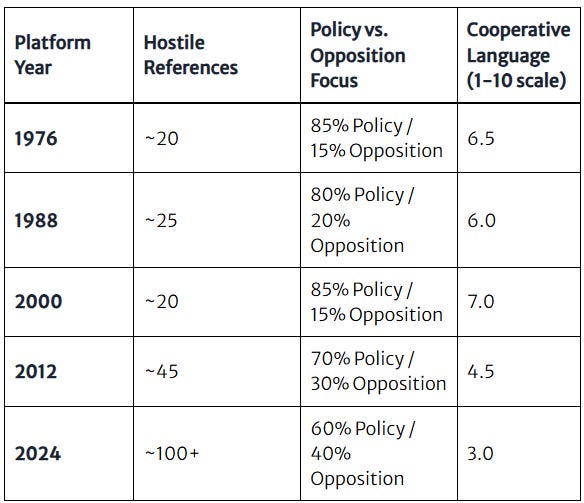
The data reveals clear trends:
Hostile references quintupled from 1976 to 2024
Opposition focus doubled from 15% to 40% of platform content
Cooperative language declined by more than half
Policy-focused content decreased from 85% to 60%
The 2024 platform spends nearly half its content framing against Republican opposition rather than presenting affirmative Democratic vision.
The Collapse of Welfare Reform
Perhaps the most dramatic reversal in Democratic positioning involves welfare policy, a shift that moved Democrats significantly leftward from their 1990s “Third Way” positioning.
The 1976 platform included a detailed “Welfare Reform” section proposing to replace the “inadequate and wasteful system with a simplified system of income maintenance.” It supported work requirements for able-bodied individuals and explicitly criticized the complexity of Aid to Families with Dependent Children (AFDC).
This reform language continued through the 1990s, culminating in President Clinton’s welfare reform legislation.
By 2024, “welfare reform” had vanished entirely from Democratic vocabulary. The platform now frames the issue as “Fighting Poverty” with emphasis on expanding social programs: Child Tax Credit expansion, SNAP benefits increases, and explicit opposition to “Republican cuts to social programs.”
This represents complete rhetorical reversal: from “the welfare system needs fundamental restructuring” to “social programs must be defended and expanded.” Democrats moved left on this issue, rejecting the centrist “reform” consensus they had previously championed.
What Disappeared: Bipartisan Aspiration
The 1976 platform, despite its criticism of Republican failures, acknowledged democratic pluralism: “We acknowledge that no political party…possesses answers to all of the problems that face us as a nation, but neither do we concede that every human problem is beyond our control.”
This philosophical humility, the acknowledgment that Democrats don’t have all the answers, represented a fundamentally different approach to politics. It presumed Republicans were legitimate participants in governance, Americans with different ideas about how to solve shared problems.
By 2024, this framing had disappeared entirely. The platform mentions “bipartisan” achievements—specific bills that received Republican support—but only as tactical victories, not as aspirational goals. The Bipartisan Infrastructure Law appears prominently, immediately followed by: “Not a single Republican voted for” the American Rescue Plan.
The message is clear: Bipartisanship happens only when Republicans occasionally cooperate with Democratic priorities. There’s no suggestion that Republicans might have legitimate policy insights, or that Democrats might learn from Republican governance, or that compromise represents anything more than temporary tactical necessity.
The 1976 platform spoke of “all the people.” The 2024 platform speaks of defending Democrats’ constituencies against Republican assault.
Mix of Consistency & Transformation
Here’s the remarkable paradox at the heart of Democratic evolution: The party’s core values remained remarkably stable while its rhetorical posture transformed completely.
Democrats in 1976 and Democrats in 2024 share commitment to: – Economic fairness and full employment – Universal healthcare access – Public education investment – Civil rights protection – Progressive taxation
Yet a Democrat from 1976 reading the 2024 platform would be shocked by the tone, the hostility, the apocalyptic framing, and the near-total absence of acknowledgment that Republicans might be legitimate political actors rather than existential threats.
This is the central insight: Democrats didn’t betray their values. They changed how they talked about defending them.
The Centercratic Observation
The Democratic Party’s transformation from 1976 to 2024 isn’t an anomaly. It’s predictable. It’s the natural endpoint of a two-party system where each party faces identical incentive structures that reward polarization and punish moderation.
Both major parties have abandoned the center for their respective edges. Democrats moved left on social programs, identity politics, and cultural issues. Republicans moved right on immigration, cultural battles, and institutional distrust. Both replaced coalition-building with tribal mobilization. Both now describe political opponents not as fellow citizens with different ideas, but as threats to America itself.
The Democratic platforms document this with precision. The shift from “we acknowledge no party has all the answers” (1976) to “extreme MAGA allies are ripping away our bedrock personal freedoms” (2024) isn’t about individual politicians becoming more partisan. It’s about a system that makes moderation structurally impossible.
Consider the mechanics: A Democratic politician who acknowledges any Republican policy success faces progressive activists questioning their commitment. A Democrat who negotiates across the aisle faces primary challenges funded by left-wing donors. The incentive structure punishes compromise and rewards purity. The center hasn’t been abandoned accidentally; it’s been systematically defunded and primaried out of existence on both sides.
For Democrats reading this: Your party transformed. The platforms prove it. The question isn’t whether this analysis is fair, it’s whether you’re comfortable with a party that spends 40% of its platform content attacking Republican opposition, or whether you recognize this rhetoric makes coalition governance impossible.
For Republicans reading this: Your parallel transformation has been documented with equal rigor. The mechanisms are identical; the directions differ. Neither party has moral high ground here. Both have chosen polarization over persuasion.
For everyone else: This is why the Centercratic Party exists. Not to attack either side, but to occupy what both abandoned: the center, where most Americans actually live. A place where you can hold principles without treating opponents as civilizational threats. Where you can win elections by building coalitions rather than mobilizing outrage. Where you can govern through compromise rather than perpetual warfare.
The Paralytic Situation at Hand
When a major party describes political opponents as “ripping away freedoms,” “eroding democracy,” and threatening the “very way of life” of Americans, compromise becomes structurally impossible.
You cannot negotiate with existential threats. You cannot find middle ground with those you’ve defined as attacking democracy itself. You cannot compromise on freedom and rights. Either you defend them absolutely, or you betray them.
The 2024 Democratic platform, like its Republican counterpart, presents an integrated vision that connects every issue to every other issue, making partial progress impossible. Moving on healthcare requires winning on everything. Addressing climate requires comprehensive Democratic governance. Protecting voting rights requires defeating Republicans everywhere. The framework allows no space for incremental progress through bipartisan cooperation.
This explains our current paralysis. It’s not about which party controls Congress. It’s that both parties have adopted frameworks that make coalition governance mathematically incompatible with their stated positions. When both parties define politics as existential warfare rather than legitimate competition, the inevitable outcome is the gridlock we witness today.
What the Data Shows
Across 48 years, the Democratic Party:
Remained ideologically consistent on core economic and social justice commitments
Dramatically expanded the scope of rights and groups receiving protection
Shifted from aspirational to defensive on traditional domestic policies
Became significantly more partisan in language, framing, and opposition focus
Moved left on some issues (social programs, gun safety) while maintaining center on others
Multiplied hostile references to Republicans five-fold
Abandoned cooperative rhetoric almost entirely
Transformed opposition from policy disagreement to existential threat
The most concerning finding is the rhetorical transformation. While policy positions show rational evolution responding to changing circumstances, the language of opposition shows a political system under severe strain. The 2024 platform treats Republican opposition as an existential threat to democracy, not as legitimate political difference within a shared democratic system.
The most encouraging finding is the consistency of values. Despite massive social, economic, and technological change, Democratic commitment to economic fairness, expanded rights, and public investment remained stable across five decades.
The platforms reveal a party that knows what it stands for, but increasingly frames those values as under constant assault, leading to more defensive posture and more hostile rhetoric. Whether this serves Democrats’ electoral interests or America’s democratic health remains an open question.
The Path Forward
Forty-eight years of platforms document how we arrived at this moment. A paralyzed Congress shows what this produces.
The Democratic Party’s evolution from bridge-builder to wall-builder mirrors a broader transformation in American politics. Both major parties now operate from the same playbook: maximize base mobilization, treat opponents as illegitimate, describe politics as warfare, and make compromise structurally impossible.
This isn’t sustainable. A democracy requires loyal opposition where parties disagree on policy while accepting each other’s legitimacy. When both parties define the other as an existential threat, democratic competition becomes impossible.
The platforms don’t lie. The language transformation is measurable. The question is whether Americans will demand that their parties return to viewing political opponents as fellow citizens rather than enemies of the state.
The Centercratic Party exists because the center didn’t disappear, it was abandoned. Most Americans don’t want warfare. They want governance. They want solutions. They want leaders who can disagree without declaring war.
The data is clear.
The transformation is documented.
The choice is yours.