


For the overwhelming majority of recorded history, human societies have been governed by concentrated power: monarchs, emperors, military strongmen, priestly castes, landed oligarchies, or some fusion of these. The democratic republic, in which political authority derives from the governed and is exercised through accountable institutions constrained by law, is not the natural or default condition of political life. It is, in the strictest empirical sense, an anomaly. The city-state experiments of ancient Athens in the sixth century BCE represented early and fragile exceptions to millennia of hierarchical rule, and even those excluded the vast majority of their inhabitants from political participation. From Aristotle’s classification of regimes (which, notably, treated democracy as a deviant form alongside tyranny and oligarchy) through Montesquieu’s tripartite division of republican, monarchical, and despotic governments, Western political thought has consistently recognized that political systems cluster along a wide spectrum of possibilities, and that the democratic form occupies a narrow and precarious band within it.1,2,3,4,5
That precariousness is not merely historical. As of 2025, the Varieties of Democracy (V-Dem) Institute reports that autocracies once again outnumber democracies worldwide, 91 to 88, for the first time in two decades. Liberal democracies, at just 29, remain the rarest form of governance on earth. Less than 12 percent of the world’s population now lives under what can reasonably be classified as a liberal democracy, while 72 percent (some 5.8 billion people) live under autocratic rule. Freedom House, in its 2025 report, documents a nineteenth consecutive year of global decline in political rights and civil liberties, with 60 countries deteriorating and only 34 improving. The third wave of democratization that Samuel Huntington identified beginning in the mid-1970s, a period during which more than thirty countries transitioned from authoritarian to democratic governance, has not only stalled but is being actively reversed across multiple continents.6,7,8
Democracy as a System, Not a Single Institution
These patterns underscore a central insight from the comparative politics literature: democracy is not a thing that simply happens when elections are held. It is not a natural byproduct of economic growth, cultural affinity, or good intentions. It is, as Linz and Stepan argued in their foundational work on democratic consolidation, “more than a regime; it is an interacting system.” Schmitter and Karl similarly emphasized that “there are many types of democracy” and that modern democracy “offers a variety of competitive processes and channels for the expression of interests and values: associational as well as partisan, functional as well as territorial, collective as well as individual.” Dahl’s concept of polyarchy identified at least eight institutional guarantees (from universal suffrage and free elections to freedom of expression, alternative information sources, and associational autonomy) as necessary for a political system to approximate democratic governance. The absence of even one of these conditions renders the democratic character of a regime questionable.9,10,11,12
The intellectual tradition from which the nine-pillar framework draws has always insisted that no single mechanism, not elections alone, not a constitution alone, not a free press alone, constitutes democracy. Lipset’s landmark 1959 study demonstrated that the conditions sustaining democratic stability are not narrowly political but extend deep into a society’s economic structure, educational attainment, urbanization, and the breadth of its middle class. O’Donnell’s analysis of “delegative democracies” in Latin America showed what happens when elections coexist with the absence of horizontal accountability: presidents govern unconstrained by independent institutions, the rule of law erodes, and the formal apparatus of democracy becomes a shell for quasi-authoritarian rule. Levitsky and Ziblatt documented how democracies now die not with a dramatic coup but through gradual erosion from within, as elected leaders use the very institutions of democratic governance to hollow out their substance.13,14,15,16,17,18
The Spectrum of Political Possibilities
A society that lacks the structural and cultural conditions for democracy does not necessarily descend into anarchy or collapse. The absence of these conditions more commonly produces one of the many alternative arrangements that political science has catalogued across centuries and civilizations: oligarchies in which economic elites govern without accountability to a broader public; theocracies in which religious authority subsumes political authority; single-party states in which a vanguard organization monopolizes power; military regimes in which coercive capacity replaces consent; or, increasingly in the contemporary period, hybrid regimes that maintain the formal architecture of democracy (elections, legislatures, courts) while systematically draining it of genuine competitive content. Levitsky and Way’s concept of “competitive authoritarianism” captures precisely this phenomenon: regimes where “meaningful electoral competition” exists but the playing field is so tilted that the opposition can never realistically win. The V-Dem Institute’s identification of 17 “grey zone” countries in 2025, states that hover at the boundary between electoral democracy and electoral autocracy, illustrates how porous and contested the frontier between democratic and non-democratic governance has become.19,20,21,22,8
Acemoglu and Robinson’s framework of inclusive versus extractive institutions reinforces this point from a different analytical angle. Inclusive political institutions (those that distribute power widely, constrain elites, and maintain accountable governance) are, in their analysis, “fragile exceptions” to the historical norm of extractive arrangements in which a narrow ruling class captures the state for private benefit. The “vicious cycle” of extraction represents the default trajectory of political organization; inclusive institutions flourish only under specific and deliberately maintained conditions, “much like delicate flowers in a greenhouse.”23,24
Why Conditions Must Be Specified
It is precisely because democracy is neither inevitable nor self-sustaining that political science has devoted enormous intellectual energy to identifying the conditions under which it can be established, consolidated, and maintained. Linz and Stepan specified five interconnected arenas (civil society, political society, the rule of law, a usable state bureaucracy, and an institutionalized economic society) arguing that “in addition to a functioning state, five other interconnected and mutually reinforcing conditions must be present, or be crafted, in order for a democracy to be consolidated.” Their insistence on the word “crafted” is significant: these conditions do not emerge spontaneously but must be deliberately constructed through political action, institutional design, and sustained civic commitment. A consolidated democracy, in their formulation, is one in which democracy has become “the only game in town,” not merely in the sense that it wins elections, but behaviorally (no significant group seeks to overthrow it), attitudinally (the overwhelming majority views democratic procedures as the only legitimate path to power), and constitutionally (all actors resolve conflict within established democratic norms).10
Dahl’s theoretical contribution was to move the definition of democracy beyond the minimalist “electoralist” fallacy, the notion that holding elections, even reasonably competitive ones, is sufficient to qualify a state as democratic. His eight institutional guarantees for polyarchy established that civil liberties are not ancillary benefits of democracy but procedural prerequisites without which the electoral process itself cannot function in a genuinely democratic manner. A society that holds elections but suppresses freedom of association, controls information flows, or criminalizes political opposition has not achieved democracy in any analytically meaningful sense. It has achieved, at most, what Zakaria termed an “illiberal democracy” or what more skeptical scholars classify as electoral authoritarianism.11,22,25
Lipset’s contribution added a further dimension by demonstrating that democratic stability correlates powerfully with socioeconomic conditions, not because wealth causes democracy through some mechanical process, but because economic development tends to generate a larger middle class, greater educational attainment, a more pluralistic civil society, and reduced dependence on a domineering state. The relationship is probabilistic, not deterministic. Poor countries can sustain democratic institutions and wealthy ones can succumb to authoritarian drift. Yet the correlation has proven remarkably durable across six decades of empirical research.15,13
The Purpose of This Framework
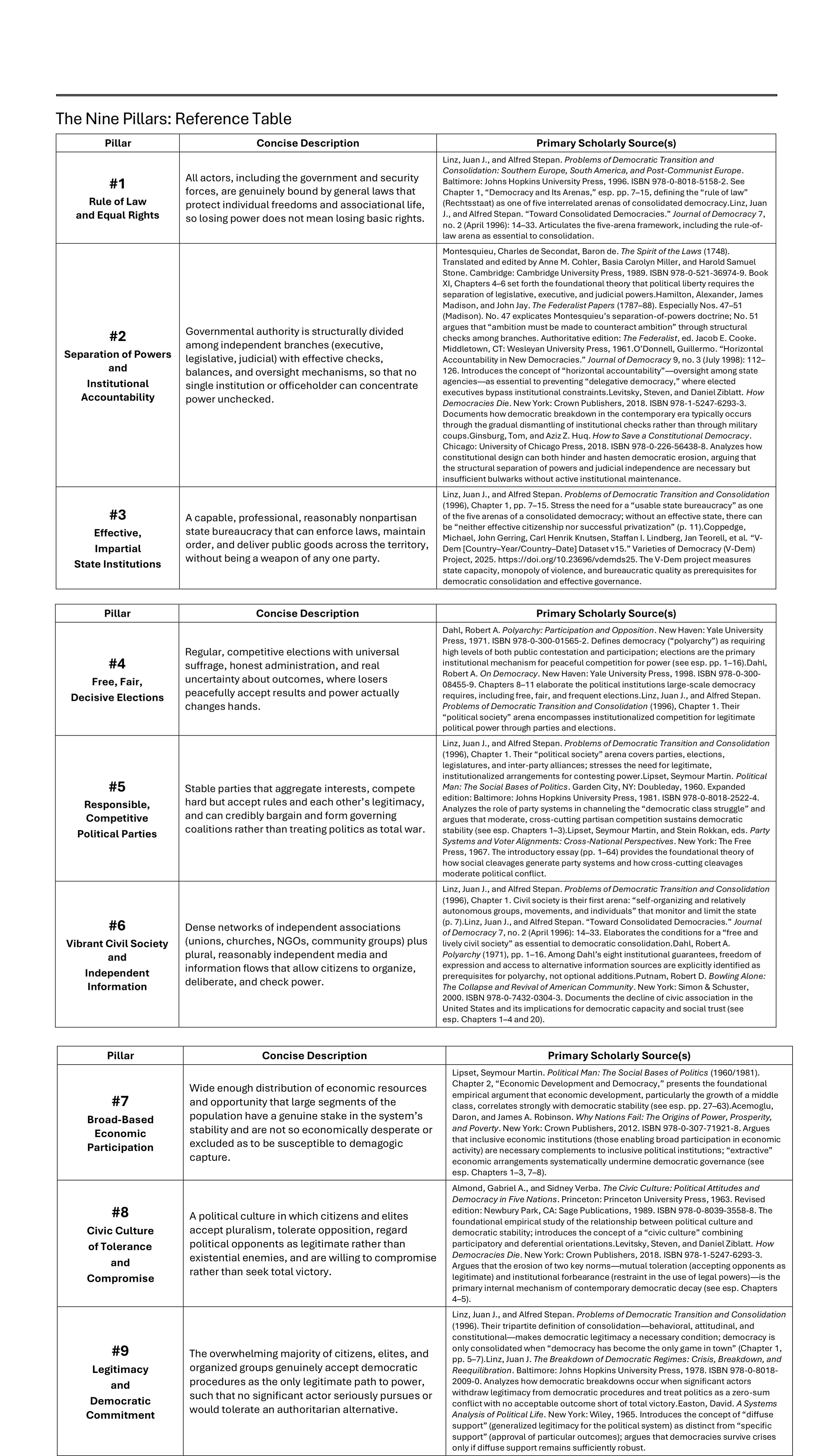
The nine pillars presented in the table that follows represent an original synthesis that integrates these distinct but convergent scholarly traditions into a single accessible architecture. They draw upon Linz and Stepan’s arenas of consolidation, Dahl’s institutional guarantees for polyarchy, Lipset’s socioeconomic correlates of democratic stability, and the separation-of-powers tradition running from Montesquieu through the American Founders to O’Donnell’s concept of horizontal accountability and the contemporary literature on democratic backsliding.26
The framework is organized in a deliberate sequence, moving from structural legal foundations through institutional mechanisms of governance to the socioeconomic, cultural, and attitudinal conditions that sustain democracy over time. This ordering reflects logical priority, not relative importance; the pillars are interconnected and mutually reinforcing, such that weakness in one necessarily affects the viability of the others. A state that holds free elections but lacks an impartial bureaucracy to implement the winners’ mandate has a procedural democracy without operational capacity. A state with robust institutions but no civic culture of compromise and tolerance has a constitutional architecture without the social fabric to prevent it from being captured by maximalist factions. A state with all of the above but without a broad commitment to democratic legitimacy itself remains one crisis away from an authoritarian reversion.26
What this framework provides, then, is neither a utopian prescription nor a mechanistic checklist. It is an empirically grounded diagnostic instrument, a way of assessing whether the full range of conditions that the comparative politics literature has identified as necessary for genuine, durable democratic governance are present, weakened, or absent in any given polity. For political scientists, policymakers, and citizens who take the democratic project seriously, the framework provides a common analytical vocabulary for identifying where the structure is sound, where it is under stress, and where it is failing, before the failure becomes irreversible.
The nine pillars are presented in a deliberate sequence—from structural foundations to sustaining culture—reflecting the logical architecture of a working democratic republic. The sequence moves from the most foundational legal and structural conditions (Pillars 1–3), through the institutional mechanisms of democratic governance (Pillars 4–6), to the socioeconomic, cultural, and attitudinal conditions that sustain democracy over time (Pillars 7–9). The pillars are interconnected and mutually reinforcing; none stands alone, and the ordering implies logical priority, not relative importance.
Endnotes
1 Aristotle, Politics, trans. C. D. C. Reeve (Indianapolis: Hackett Publishing, 1998), Book III, Chapters 6–7. Aristotle’s sixfold typology of regimes classifies democracy (demokratia) as a deviant form in which the poor rule in their own interest rather than the common good.
2 Montesquieu, Charles de Secondat, Baron de, The Spirit of the Laws (1748), trans. and ed. Anne M. Cohler, Basia Carolyn Miller, and Harold Samuel Stone (Cambridge: Cambridge University Press, 1989), ISBN 978-0-521-36974-9, Books II–III (tripartite division of republican, monarchical, and despotic governments) and Book XI, Chapters 4–6 (liberty and separation of powers).
3 Dahl, Robert A., Polyarchy: Participation and Opposition (New Haven: Yale University Press, 1971), ISBN 978-0-300-01565-2, pp. 1–16. Dahl’s analysis places competitive democracy as a rare empirical outcome requiring specific institutional conditions rather than a natural political equilibrium.
4 Linz, Juan J., and Alfred Stepan, Problems of Democratic Transition and Consolidation: Southern Europe, South America, and Post-Communist Europe (Baltimore: Johns Hopkins University Press, 1996), ISBN 978-0-8018-5158-2, Chapter 1, pp. 3–7 (defining the conditions that make democracy the rare exception rather than the norm).
5 Huntington, Samuel P., The Third Wave: Democratization in the Late Twentieth Century (Norman: University of Oklahoma Press, 1991), ISBN 978-0-8061-2516-9, Chapter 1, pp. 3–30. Huntington documents democracy’s historical rarity and argues that democratization has occurred in distinct regional and temporal waves, each followed by a reverse wave.
6 Coppedge, Michael, John Gerring, Carl Henrik Knutsen, Staffan I. Lindberg, Jan Teorell, et al., “V-Dem [Country–Year/Country–Date] Dataset v15,” Varieties of Democracy (V-Dem) Project, 2025, https://doi.org/10.23696/vdemds25. The V-Dem dataset is the authoritative cross-national source for regime classification; its 2025 annual report documents the reversal in the ratio of democracies to autocracies.
7 Freedom House, Freedom in the World 2025 (Washington, DC: Freedom House, 2025), https://freedomhouse.org/report/freedom-world/2025/. Documenting a nineteenth consecutive year of global democratic decline, with 60 countries recording net declines in political rights and civil liberties and only 34 recording net gains.
8 Lührmann, Anna, and Staffan I. Lindberg, “A Third Wave of Autocratization Is Here: What Is New About It?” Democratization 26, no. 7 (2019): 1095–1113. Provides the scholarly framework for understanding the contemporary “third wave of autocratization,” including the V-Dem data on grey-zone and hybrid regimes, which is updated annually in the V-Dem Democracy Report series.
9 Schmitter, Philippe C., and Terry Lynn Karl, “What Democracy Is . . . and Is Not,” Journal of Democracy 2, no. 3 (Summer 1991): 75–88. Defines modern democracy as a system of governance with competing rulers held accountable by citizens through indirect participation, and emphasizes that “there are many types of democracy.”
10 Linz, Juan J., and Alfred Stepan, “Toward Consolidated Democracies,” Journal of Democracy 7, no. 2 (April 1996): 14–33. Articulates the five-arena framework and the tripartite (behavioral, attitudinal, constitutional) definition of democratic consolidation, including the concept of democracy as “the only game in town.”
11 Dahl, Robert A., Polyarchy: Participation and Opposition (1971), pp. 1–16. Dahl identifies eight institutional guarantees as necessary for polyarchy, including freedom of expression, alternative information sources, and associational autonomy, establishing that civil liberties are procedural prerequisites rather than optional supplements.
12 Dahl, Robert A., On Democracy (New Haven: Yale University Press, 1998), ISBN 978-0-300-08455-9, Chapters 8–11.
13 Lipset, Seymour Martin, “Some Social Requisites of Democracy: Economic Development and Political Legitimacy,” American Political Science Review 53, no. 1 (March 1959): 69–105. The landmark empirical article establishing that economic development, education, urbanization, and middle-class formation correlate with democratic stability.
14 Lipset, Seymour Martin, Political Man: The Social Bases of Politics (Garden City, NY: Doubleday, 1960; expanded ed. Baltimore: Johns Hopkins University Press, 1981), ISBN 978-0-8018-2522-4, Chapters 1–3.
15 O’Donnell, Guillermo, “Delegative Democracy,” Journal of Democracy 5, no. 1 (January 1994): 55–69. Introduces the concept of “delegative democracy,” in which elected presidents govern unconstrained by horizontal accountability, eroding the rule of law and institutional checks while maintaining electoral legitimacy.
16 O’Donnell, Guillermo, “Horizontal Accountability in New Democracies,” Journal of Democracy 9, no. 3 (July 1998): 112–126.
17 Levitsky, Steven, and Daniel Ziblatt, How Democracies Die (New York: Crown Publishers, 2018), ISBN 978-1-5247-6293-3. Argues that contemporary democratic erosion occurs through the gradual capture of institutions by elected leaders rather than through military coups, documenting historical and contemporary cases.
18 Ginsburg, Tom, and Aziz Z. Huq, How to Save a Constitutional Democracy (Chicago: University of Chicago Press, 2018), ISBN 978-0-226-56438-8.
19 Levitsky, Steven, and Lucan A. Way, “The Rise of Competitive Authoritarianism,” Journal of Democracy 13, no. 2 (April 2002): 51–65. Introduces the concept of “competitive authoritarianism” to describe regimes where formal democratic institutions exist but the playing field is systematically tilted in favor of incumbents.
20 Levitsky, Steven, and Lucan A. Way, Competitive Authoritarianism: Hybrid Regimes After the Cold War (Cambridge: Cambridge University Press, 2010), ISBN 978-0-521-71270-0.
21 Diamond, Larry, “Thinking About Hybrid Regimes,” Journal of Democracy 13, no. 2 (April 2002): 21–35. Provides a taxonomy of hybrid regimes, including competitive authoritarian, hegemonic electoral authoritarian, and ambiguous cases, complementing Levitsky and Way’s framework.
22 Zakaria, Fareed, “The Rise of Illiberal Democracy,” Foreign Affairs 76, no. 6 (November/December 1997): 22–43. Introduced the concept of “illiberal democracy” to describe elected regimes that systematically violate constitutional liberalism and civil rights, anticipating many features of later competitive authoritarianism literature.
23 Acemoglu, Daron, and James A. Robinson, Why Nations Fail: The Origins of Power, Prosperity, and Poverty (New York: Crown Publishers, 2012), ISBN 978-0-307-71921-8, Chapters 1–3 and 7–8. Develops the inclusive-versus-extractive institutions framework, arguing that inclusive political and economic institutions are “fragile exceptions” to the historical norm of extraction.
24 Acemoglu, Daron, and James A. Robinson, The Origins of Power, Prosperity, and Poverty (2012), p. 430 (“much like delicate flowers in a greenhouse”); see also the discussion of vicious and virtuous cycles in Chapters 3 and 11.
25 Schedler, Andreas, “The Menu of Manipulation,” Journal of Democracy 13, no. 2 (April 2002): 36–50. Documents the range of electoral manipulations short of outright fraud through which incumbents undermine electoral integrity in hybrid and competitive authoritarian regimes.
26 The nine-pillar framework synthesizes Linz and Stepan’s five-arena model (Problems of Democratic Transition and Consolidation, 1996); Dahl’s eight institutional guarantees (Polyarchy, 1971); Lipset’s socioeconomic correlates (“Some Social Requisites of Democracy,” 1959; Political Man, 1960); Montesquieu’s separation-of-powers theory (The Spirit of the Laws, 1748); O’Donnell’s horizontal accountability framework (“Horizontal Accountability in New Democracies,” 1998); and the democratic backsliding literature, especially Levitsky and Ziblatt (How Democracies Die, 2018) and Ginsburg and Huq (How to Save a Constitutional Democracy, 2018).